 |
Replacements | |
|
|
The name of this page is a little misleading because these are the images that have been replaced, not the new ones. Only images which were significantly improved will be shown. Minor changes, like minimal reprocessing of the original data, will not be included. |
|
|
NGC 205 (M110) NGC 869 & 884 (Double Cluster) NGC 891 NGC 925 NGC 1023 and 1023A (Arp 135) NGC 2403 NGC 2548 (M48) NGC 4236 NGC 5236 (M83) NGC 5426 & 5427 (Arp 271) NGC 6656 (M22) NGC 6951 and Cirrus |
IC 417 (Sharpless 2-234) |
|
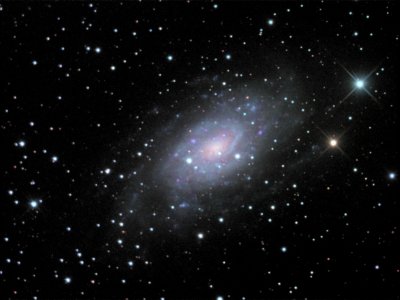
10-inch Newtonian, ST2000XM, 40:24:24:28 minutes NGC 2403 is one of the big, bright, far northern galaxies. It is 11' x 18' in size, and 8.4 magnitude. It has strong blue inner arms, and more tenuous yellowish outer arms, but there are a number of bright star-forming regions in the outer arms. They, of course, tend to be very blue. The core is not as yellow as most of the other galaxy images seen here and on the Galaxies page. |
||

 |
||
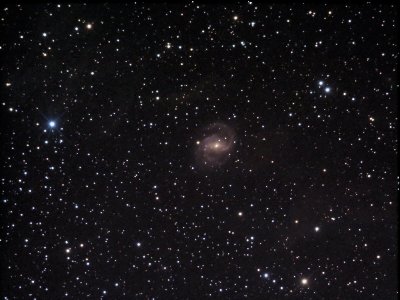
10-inch Newtonian, ST2000XM, 88:28:28:28 NGC 6951 is a lovely barred spiral, very yellowish in color. But perhaps the most interesting thing about this image is the faint dust clouds just visible in the background. These are called galactic cirrus. They are most visible at high galactic latitudes but can be found almost anywhere with a deep enough exposure. The dust is illuminated by the integrated flux of all the stars in the Milky Way, rather than by any particular object. NGC 6951 is a Seyfert 2 galaxy with low surface brightness. |
||

 |
||
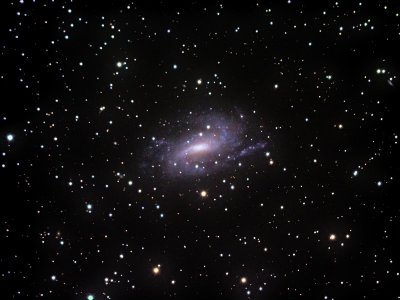
10-inch Newtonian, ST2000XM, 80:24:24:24 NGC 925 is a large, loose barred spiral. The arms are very unsymmetrical and there is obviously a lot of star formation going on. This galaxy shows up a lot in the literature but mostly in surveys and catalogs, or regarding aspects only of interest to professionals. There is an interesting little galaxy nestled among a group of stars just E (left) of NGC 925. Other than a number, 2MASX J02274393+3332286, and a couple of diameters, 5.1" and 6.4", there is no data available on it, but I suspect it might be a companion. |
||
|
|
||
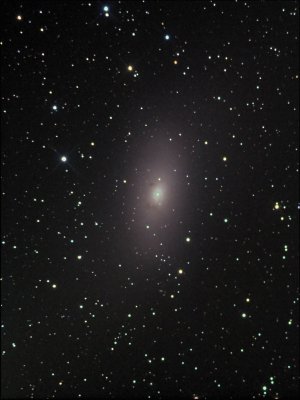
10-inch Newtonian, ST2000XM, 40:40:40 M110 was not actually cataloged by Messier, but was included in a sketch he made of the Andromeda Galaxy, M31. It was independently discovered by Caroline Herschel about 10 years later. It is classified as a dwarf elliptical but is unusual for this class because it shows dust, some star formation, and hints of structure (spiral?) in the central part. It is being slowly cannibalized by M31, and this can be seen in the image as a faint bridge of stars curving off to the lower left. The bridge is just a glow as the individual stars are much too faint to be resolved. |
||

 |
||
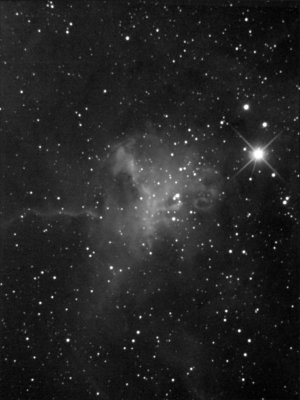
10-inch Newtonian, ST2000XM, 64(+80 H-a):24:24:24 This object is so much more interesting and attractive in H-alpha that I have used the H-alpha image for the thumbnail. The Half and Full size images are in color, and the H-a buttons link to full and half size H-alpha images. This object consists of a sparse cluster enveloped in a cloud of glowing gas, mostly hydrogen. It is sometimes called the Spider Nebula, and the nearby object NGC 1931 (outside this field) is called the Fly. To me, IC 417 could be called the Angler, if viewed with south up, after the fish with the huge mouth and wormlike head appendage it uses as a lure. The tendril (appendage) heading off to the left edge of the field looks like an tiny emission version of the Cocoon. My H-alpha image is not as sharp as it should be because I forgot to focus when I switched to this filter. All my other filters are parfocal but this one is not. |
||



 |
||
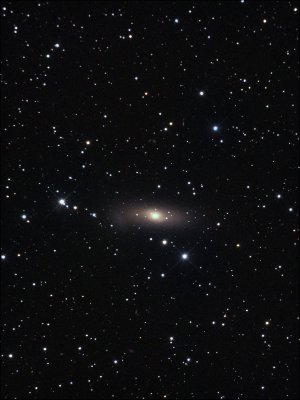 NGC 1023 and 1023A (Arp 135) 10-inch Newtonian, ST2000XM, 70:24:24:24 NGC 1023 is the large yellow galaxy in the center of the field. It is classified as SB(rs)0- but the bar is not very obvious in this image. It is slightly easier to see (or imagine?) in a shorter exposure. NGC 1023A is the small bluish galaxy at the E (left) end of 1023. It is classified as IB?. Together, they make up Arp 135. There is another small galaxy, PGC 10169, hiding in the glare of the bright star to the left of Arp 135, and some tiny background galaxies or dwarf companions throughout the field. NGC 1023A is much easier to see in this color image than it is in monochrome images, because of the color contrast. NGC 1023A is more granular, or knotty, than 1023, which has a very smooth texture -- check this on the full size image. 1023A also has some small and indistinct absorption features, which appear to me to be organized into a crude ring shape. |
||
|
|
||
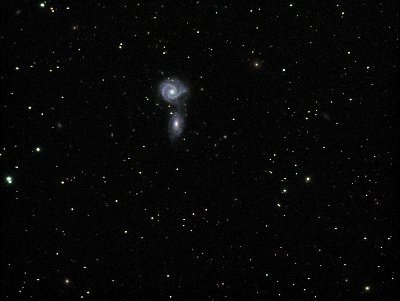
10-inch Newtonian, ST2000XM, 100:30:30:30 Arp 271 will always be special to me because it was the last image to complete my collection of all 338 Arps. It is a beautiful one, and was a nice way to finish. This color version is much deeper than the earlier monochrome. The upper galaxy is NGC 5427 and the lower is 5426. The interaction appears to have disturbed 5426 more than 5427, as it has a host of star-forming knots, but neither has been extremely distorted. The eastern arm of 5427 is forked (bifurcated) and sweeps down into 5426 (or vice versa). It is possible that our Milky Way and the Andromeda Galaxy will have a similar interaction in a few million years. |
||

 |
||
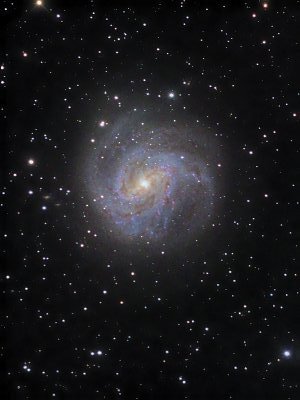
10-inch Newtonian, ST2000XM, 48:16:16:16 This large, bright barred spiral is a beautiful object. The intricate dust lanes add to the interest, and there are a few pink hydrogen alpha regions visible. The exposures should have been longer but it is such a bright object that it still shows well. Conditions were also marginal, with poor transparency, and the sky was completely clouded out within 5 minutes after I finished the last blue sub-exposure. The largest of the small pair of galaxies East (left) of M83 is ESO 444-85. Somewhat surprisingly, there are not a lot of background galaxies in this area. |
||
|
|
||
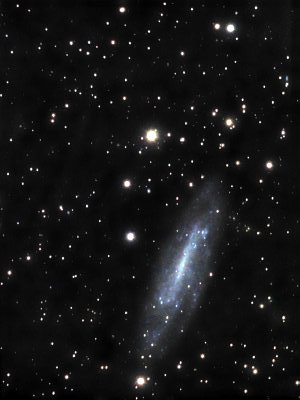
Meade 2045D, ST2000XM, 130:40:40:40, 40' x 29' This was my one and only image from the 2010 Texas Star Party. I spent three nights determining that I had a broken wire inside a 9-pin connector, which was preventing me from guiding, and there were a couple of "iffy" weather nights. NGC 4236 is a huge galaxy, 22' x 7.2', with a magnitude of 10.1, and has a very low surface brightness. In three different catalogs, S.B. is listed as 15.0, 16.0, and 23.5 mag./sq. arc sec. The last one is obviously an error, but it is dim. I was imaging at f/10, which didn't help, but there was no hint of the galaxy in 10-minute color sub-exposures until I turned on log scaling. It is a barred spiral and has some interesting features, especially the bright blue "hook" just above and to the left of the core. |
||

 |
||
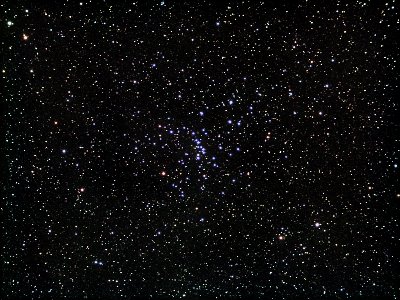
Astro-Tech AT66ED, ST2000XM, 16:16:16:16 minutes, 76' x 102' This very young, very blue, cluster occupies the center 54' of the field but does not really stand out. Somewhat surprisingly, it is much more obvious in my 9 x 50 finder than in the image. The image includes a huge number of background stars that are below the magnitude visible in the finder. To me, the most interesting things about this cluster are a horseshoe shaped collection of stars with the closed end at the center of the field and opening to the lower left (SE), and several long chains of stars just above the cluster that look almost like writing. |
||
|
|
||
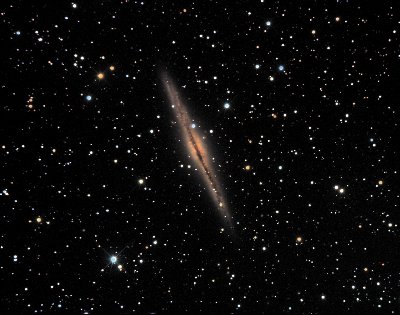 NGC 891
10-inch Newtonian, ST2000XM, 100:32:32:32 minutes NGC 891 has always been a nice object to image. It is about as good an example of an edge-on spiral as there is. This version has much improved focus and 28 minutes more exposure compared to the earlier version. |
||

 |
||
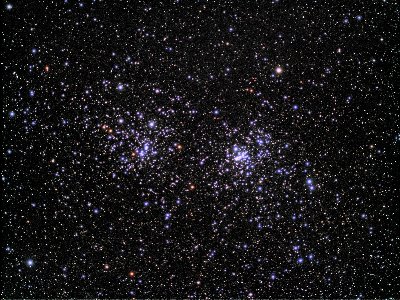 Double Cluster (NGC 869 & 864)
Astro-Tech AT66ED, ST2000XM, 30:16:16:16 minutes, 76' x102' This is an image made from my backyard in The Woodlands, TX. Open clusters are about the only deep sky objects which can be easily be imaged with the light pollution, except for bright and planetary nebulae using narrowband filters. The Double Cluster is a beautiful object visually, even with binoculars or a small telescope. In dark skies, it can be found fairly easily with the naked eye. This improves on the previous version by having triple the exposure time, 1x1 binning, and no Moon lighting up the scene. |
||
|
|
||
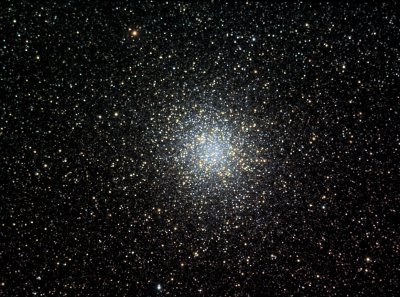 NGC 6656 (M22) 10-inch Newtonian, ST2000XM, 34:22:20:20 minutes M22 is large, bright, and resolvable to the core. It has an attractive mix of star colors. It ranks second behind M13 for the brightest globular visible from mid-northern latitudes. It is also one of the nearest. Images made before and after my tube replacement were merged to produce this image, so it still shows traces of the defects typical of my older images. |
||
|
|
||
 |
||