 |
Globular Clusters |
|
|
By Messier Number
M2,
M4,
M5,
M9,
M10,
M12,
M13,
M14,
M15,
M19,
M22,
M28,
M30,
M53,
M54,
M55,
M56,
M56,
M62,
M68,
M70,
M71,
M72,
M75, By NGC Number
1904,
2419,
4590,
5024,
5139,
5466,
5634,
5897,
5904,
6093,
6121,
6171,
6205,
6218,
6254,
6266,
6273,
6333,
6341,
6402,
6544,
By Other Catalog Number or Designation Omega Centauri, Palomar 10, Palomar 12
|
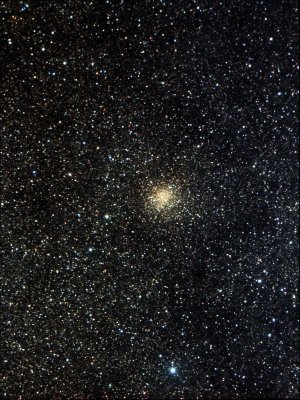
10-inch Newtonian, ST2000XM, 30:11:11:11 NGC 6553 is a very reddened globular cluster in Sagittarius. It is one of the globulars located in the galactic (Milky Way) bulge. Most of these clusters are so obscured that they cannot be studied at optical wavelengths. Dark dust lanes are visible throughout this field and even the objects not completely obscured are dimmed and reddened. The cluster is located just over a degree SE of the Lagoon Nebula, in a very rich part of the Milky Way. |
|

 |
|
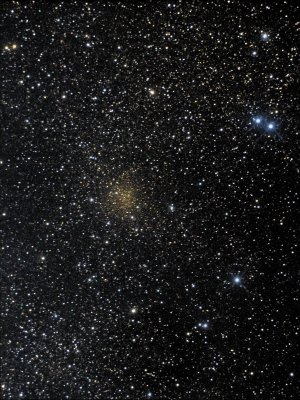
10-inch Newtonian, ST2000XM, 22/10/10/10 NGC 6749 is fainter and more reddened than even 6553 above. It, however, is a halo rather than a bulge cluster. It was the first globular discovered by John Herschel. This is a bit surprising because it is widely considered to be the most difficult NGC globular to observe visually. There is an outstanding article available on the Cloudy Nights forum titled "NGC 6749 Aquila -- Tough Cookie, Soft Heart". This article includes more detail on 6749 than any of the professional journals. Just a personal observation -- in most globular images, the globular appears to be in front of, or among the field stars. To me, 6749 definitely seems to be hiding behind them. |
|

 |
|
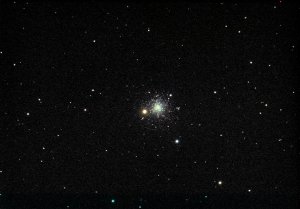
Celestron CG 9 1/4, ST2000XM, 22/10/10/10 This image was made at my home in The Woodlands, TX. 5634 is located in Virgo , well away from the Milky Way, and has fewer foreground stars than most globulars. Compare it with M9 (NGC 6333) and M79 (NGC 1904) below. NGC 5634 is believed to be a cluster "stolen" from the Sagittarius Dwarf Spheroidal Galaxy, both because of the orbit and the chemical composition. |
|

 |
|
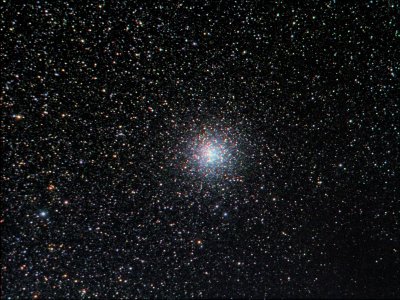
10-inch Newtonian, ST2000XM, 40:10:10:10 M9 is a fine globular, resolvable to the core but with difficulty. It is one of the closest globulars to the core of the Milky Way. As this image shows, it is in a very dusty area. About 27' west (right) of M9 is the dark nebula B64. The lower right corner of the image shows a real dearth of stars, and the same thing is seen in Megastar. While not named, the dark nebulosity must extend well beyond B64 itself. |
|

 |
|
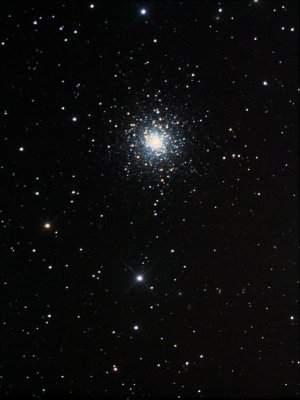
10-inch Newtonian, ST2000XM, 38:14:14:14 M79 is a bright and dense globular. It is among the most distant of the globulars on the Messier list. There is debate among astronomers about whether it was originally a Milky Way globular or, instead, was captured from the Canis Major dwarf galaxy. There are a number of tiny galaxies visible in the field. This is because M79 is located well away from the most concentrated parts of the Milky Way, almost opposite the center in Sagittarius. Also, the star background is much sparser than clusters in or near the Milky Way. |
|

 |
|
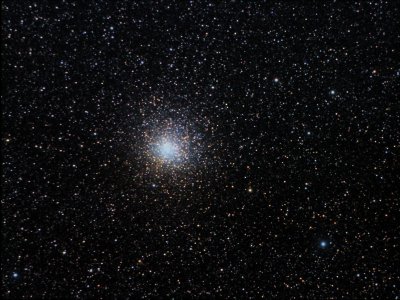
10-inch Newtonian, ST2000XM, 28:10:10:10 Messier 62 is assigned a diameter of 15' and a magnitude of 6.4. The apparent diameter is my image is less. It has been studied for the existence of an intermediate mass black hole in the core but the results have been inconclusive. It has a high number of variables, mostly of the RR Lyrae type. To me, the core appears to be slightly off-center, toward the bottom left in this image. |
|

 |
|
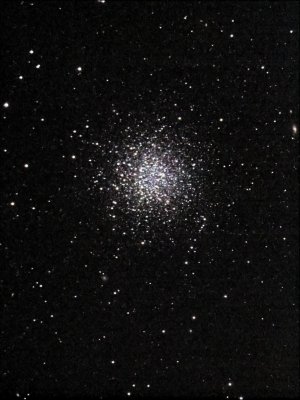
10-inch Newtonian, ST2000XM, 24:8:8:8 In an article by James Cuffey, Astronomical Journal, Vol. 66, NGC 5466 was described as an "unusually interesting high-latitude globular cluster with an extremely open, well resolved structure." That shows clearly in this image, as there is very little concentration toward the core and individual stars are easily seen right to the center. It appears less colorful than the typical globular. This image has much more background noise than normal because it was taken on a very damp, hazy night. There are several galaxies seen in the field, with the brightest, up against the right edge, being CGCG 162-58. |
|

 |
|
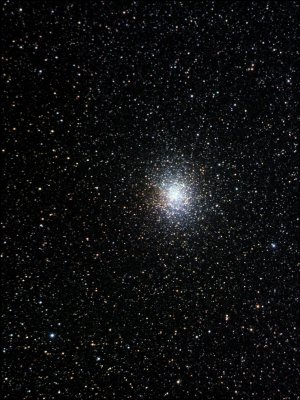
10-inch Newtonian, ST2000XM, 24:8:8:8 M19 is fairly rich and dense but is resolvable to the core. It is the most oblate (elliptical) globular known. Theories about the reason for this are diverse. One is that it is being distorted by its proximity to the core of our galaxy; another is that it is simply appearance from extinction by dust and gas along the east side. The extinction is seen in my image as the much yellower color along the east, and especially SE, side. |
|

 |
|
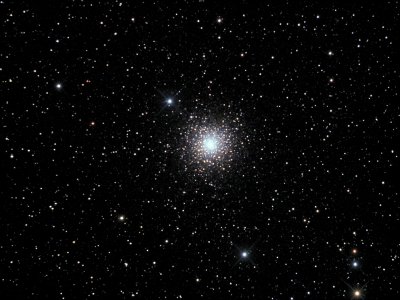
10-inch Newtonian, ST2000XM, 30:12:12:12 M80 is a very dense globular located about 4.4 degrees north and west of Antares. It is much smaller than nearby M4 and very concentrated toward the core. It is one of the few globular clusters to have produced a nova, and that was in 1860. It is believed to be one of the oldest globulars. |
|

 |
|
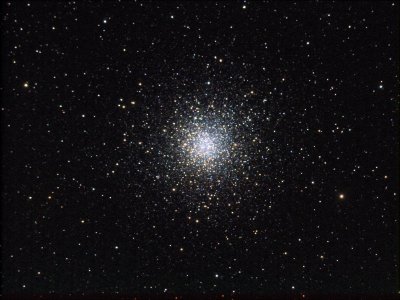
10-inch Newtonian, ST2000XM, 30:10:10:10 M10 is much larger and less concentrated than M80 above. It is easily resolvable right to the core. The stars show a wide range of color. |
|

 |
|
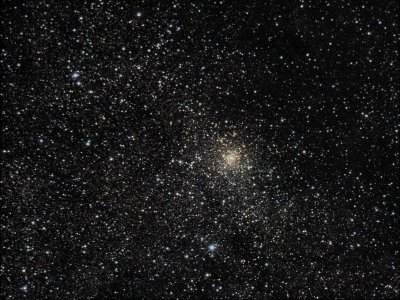
10-inch Newtonian, ST2000XM, 21:7:7:7 NGC 6544 is the third globular in a row and, looking at the three together, it is clear how different they can be. 6544 is moderately concentrated but is resolvable to the core. It is in a rich star field and it lies right at the edge of a strongly obscuring dust cloud. The upper right quarter of the field is heavily obscured and there are numerous patches of dust obscuring other parts of the field. Additionally, the dust yellows the cluster stars; there are really no blue or white stars in the cluster itself. The blue stars nearby are almost certainly foreground stars. |
|

 |
|
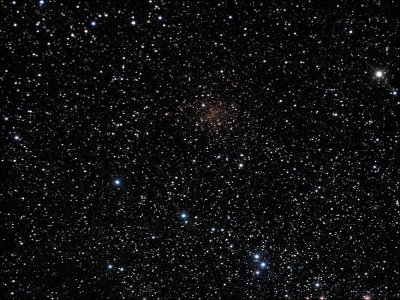
10-inch Newtonian, ST2000XM, 48:20:20:20 Yet another globular, very different from the others. The Palomar globular clusters were discovered in the 1950's on survey plates from the first Palomar Observatory Sky Survey (POSS). They cover a wide range of size and brightness, but most are small and faint, and several are heavily obscured. This is one of the heavily obscured group, and would be a fairly typical globular if not for the intervening dust. They are often used as "challenge objects" for visual observers using large telescopes. Palomar 10 is magnitude 13.2 with a diameter of 4.0'. Compare that with NGC 6544 above, with a magnitude of 7.5 and a diameter of 9.2'. NGC 6544 is 189 times brighter. |
|

 |
|
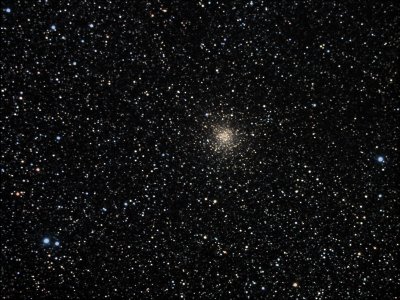
10-inch Newtonian, ST2000XM, 30:10:10:10 Other than being well resolved and in a rich star field, NGC 6760 has little to distinguish it. It is referenced in a large number of articles but few, if any, focus on this cluster. |
|

 |
|
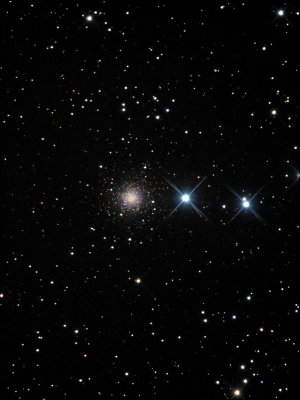
10-inch Newtonian, ST2000XM, 36:12:12:12 NGC 2419 is often called the "Intergalactic Wanderer" even though it is now known to be in orbit around our galaxy. At the most distant point in its orbit, it is about 300,000 LY from the galactic core. That is almost twice the distance of the Large Magellenic Cloud. The yellowish color compared to most globulars could be due to age but more likely the result of the amount of dust the light passes through in reaching us. Technically, this may be my best image ever. The FWHM of the stacked but unprocessed luminosity set is about 2.7 pixels, or 2.9 arc seconds. While I do better than that on individual exposures, I cannot remember ever doing it over 36 minutes.
|
|

 |
|
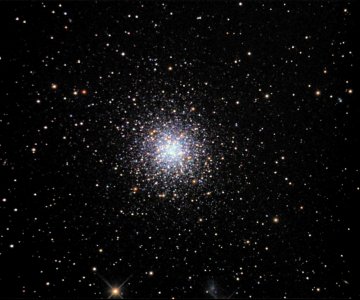
10-inch Newtonian, ST2000XM, 30:10:10:10, 21.7' x 26' M68 was discovered by Messier in 1780. For many years, there was debate about whether Messier or Mechain should be credited but the debate seems to be settled in favor of Messier. The magnitude and size have also been subject to more than the usual uncertainty. I found magnitudes varying from 7.3 to 9.7 but a value near 7.3 seems to be most accepted. The size is generally listed as about 11'. This cluster is not in the region of the sky where most clusters are found but is, instead, near the heart of galaxy concentration. There are two ESO galaxies near the bottom of the field, 506-29 just right of center and 506-26 in the lower right corner. |
|

 |
|
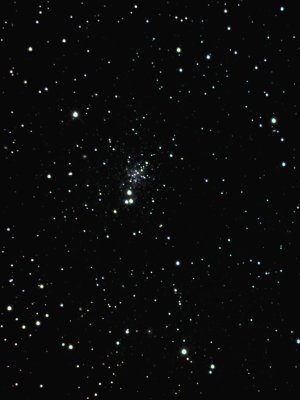
10-inch Newtonian, ST2000XM, 50:16:16:16 The Palomar globular clusters were discovered in the 1950's on survey plates from the first Palomar Observatory Sky Survey (POSS). They cover a wide range of size and brightness, but most are small and faint, and several are heavily obscured. They are often used as "challenge objects" for visual observers using large telescopes. Palomar 12 is magnitude 11.7 to 12, depending on the source, and about 2.9" in diameter. To me, it looks more like a rich and distant open cluster than a globular. Even recognizing that some of the stars within its boundaries are foreground stars, the range of brightness seems very large for a globular. At one time, it was suspected to be a dwarf galaxy in the local group, but that is no longer the consensus. |
|

 |
|
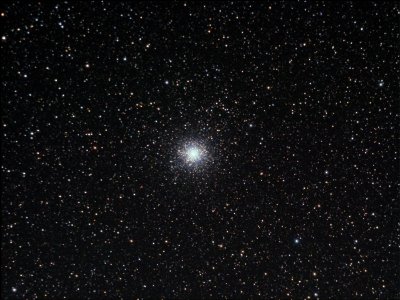
10-inch Newtonian, ST2000XM, 30:10:10:10
|
|

 |
|
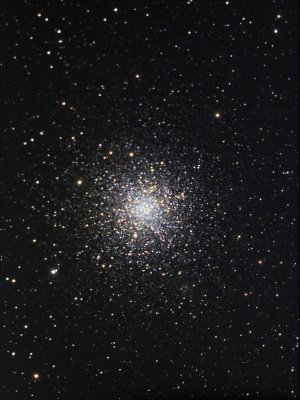
10-inch Newtonian, ST2000XM, 34:12:12:12 M12 is an attractive and colorful globular cluster, easily resolved to the core. It is relatively sparse and was at one time thought to be a dense open cluster. There appears to be some dispute about the distance; I found values ranging from 15,700 to 18,000 light years. There are quite a few galaxies in this field, with several seen through the outer parts of the cluster. I think the pair about 6' SSW of the center is the most interesting. I had not properly squared my camera with the optical axis for this image, so the stars in the upper left corner are misshapen. |
|

 |
|
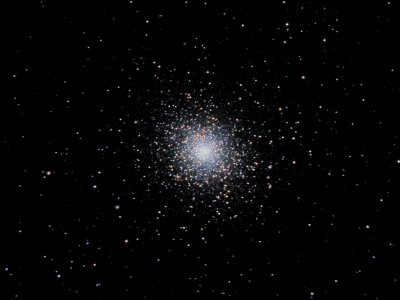
Meade 2045D @ f/10, ST2000XM, 36:12:12:12, 30.4' x 41' M5 is a large (23'), bright (5.7 magnitude), and dense globular. In very dark skies, it is just visible to the naked eye. It was discovered by Gottfried Kirch in 1702, 62 years before it was first seen by Messier. It is one of the largest and oldest globular clusters in our Milky Way. This is not a very good image. After I shot it, I discovered that my 2045D was out of collimation. The fainter stars look decent but the brighter stars have a distinct flare. |
|

 |
|
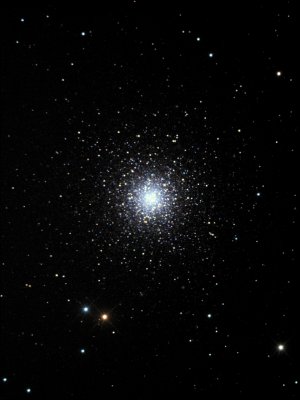
10-inch Newtonian, ST2000XM, 30:10:10:10 M53 is a large bright globular with a very bright core, and a wide range of star colors. It ranks high on my list of globs. It was originally discovered by Bode, and independently rediscovered by Messier. It is quite large, with a diameter of about 220 light years. As concentrated as it appears, there are actually huge distances between the individual stars. Because of the location in Coma, there are a lot of tiny galaxies in the field. A number of them can be seen through the outer parts of the cluster. None are very impressive and you need to look carefully to find them. |
|

 |
|
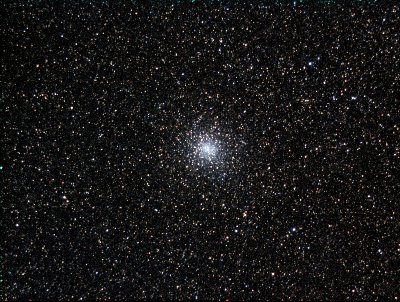
10-inch Newtonian, ST2000XM, 20:9:9:9 M29 is a medium size globular, extending well beyond its apparent size in this image. The accepted diameter is 13.8'. This field is 21.7' top-to-bottom, so the cluster covers almost 65% of that distance. The outer portions are basically lost in this rich Milky Way field. It is fairly concentrated and I could just barely resolve it in the core. There were strong, gusty winds throughout the time I was acquiring this image. I really appreciated the Sigma Clip stacking that Berry and Burnell provided with AIP4Win. Without it, I would have had to discard over half my sub-exposures. I use it routinely but it was essential for this image. |
|

 |
|
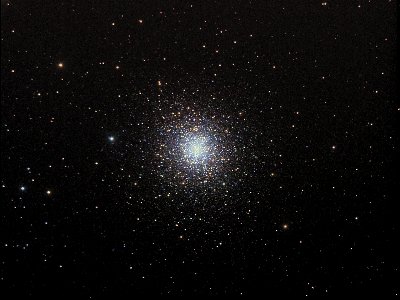
10-inch Newtonian, ST2000XM, 28:10:10:10 M92 is a wonderful globular that is often overlooked because of its proximity to M13. It is very dense and the image is just barely resolvable to the core, with a nice range of colors. It is a naked eye object under exceptional conditions.
|
|
|
|
|
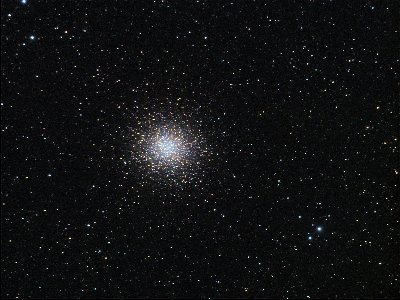
10-inch Newtonian, ST2000XM, 30:8:8:8 This is a good opportunity to compare M92 and M14 "side-by-side". M14 is a bit smaller, about a magnitude fainter, and less dense with fewer stars, compared to M92. Even so, they look quite similar. The surrounding star field for M14 is richer, as it is considerably closer to the main band of the Milky Way. This cluster has a large number of variables and is one of only two globular clusters which has produced a nova. |
|

 |
|
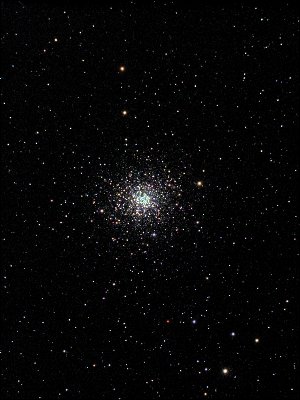
10-inch Newtonian, ST2000XM, 20:7:7:7 M107 is a loose globular cluster, resolvable to the center. It was probably the last Messier object to be discovered, and one of the last to be added to the list. It didn't make it until 1947. It appears to have a couple of darker obscured regions, especially toward the N (top), which are uncommon in globular clusters. The cluster itself is not particularly colorful, with a high percentage of white or near-white stars, but about two thirds the way from the cluster to the bottom of the field, slightly right of center, is one of the reddest stars I've ever seen in my imaging. |
|

 |
|
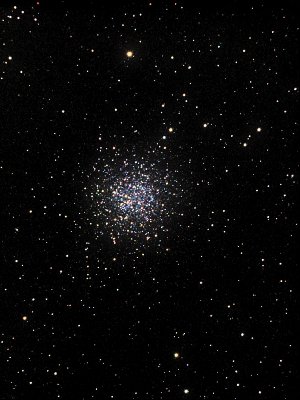
10-inch Newtonian, ST2000XM, 30:10:10:10 NGC 5897 is a large, bright, extremely loose globular cluster. It is significantly larger than M107, above, and even looser. Some of the densest open clusters are almost as concentrated but generally lack the symmetrical shape. It is very colorful compared to M107, with a high percentage of blue and yellow stars. |
|

 |
|
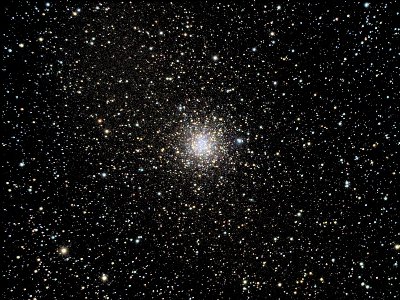
10-inch Newtonian, ST2000XM, 24:8:8:8 M56 is a very attractive globular cluster in Lyra. It is well resolved to the core and has a high concentration of yellow stars, although this color is probably partially due to obscuration by dust in the Milky Way. |
|

 |
|
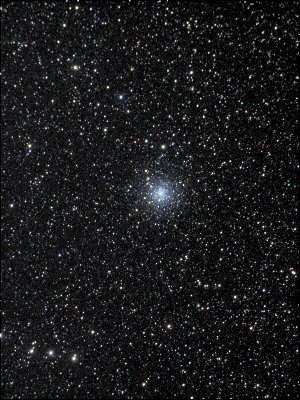
10-inch Newtonian, ST2000XM, 18:6:6:6 M70 is a small, condensed globular in Sagittarius. It is in a very rich star field, and tends to be overlooked among the wonders of this area. It is a pretty object and well worth a look. M54, M69, and NGC 6652 are all nearby, within a single field of a fairly wide-field finder. |
|
|
|
|
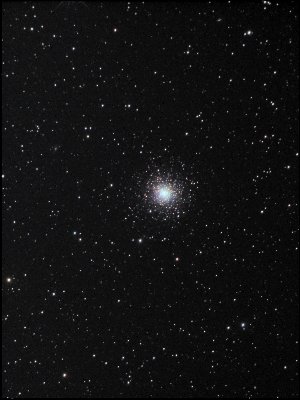
10-inch Newtonian, ST2000XM, 16:8:8:8 M75 is similar to M70 but even more condensed towards the core. This image, and the M70 image above, were made at exactly the same image scale and almost the same exposure. M75 appears to be larger and a little brighter but, in fact, the opposite is true. Measuring the size of a globular can be difficult since the star density declines gradually and determining which of the outlying stars are members requires a lot of careful research. And magnitude measurements can be skewed by a few bright stars. One aspect of the visual impression is more clear-cut: M70 is in a much richer star field. This is logical because M70 is close to the heart of the Milky Way while M75 is outside the generally mapped "edges". It is, of course, part of the galaxy but far enough from the plane to be outside the brighter parts of the disc. Because of this, several tiny background galaxies can be seen in the image. |
|
|
|
|
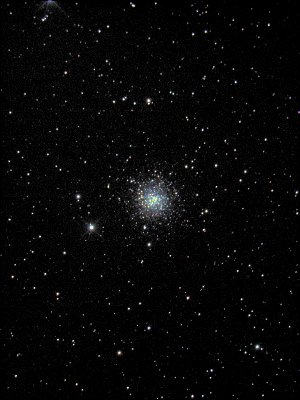
10-inch Newtonian, ST2000XM, 22:8:8:8 M72 is one of the least impressive of Messier's globulars, especially visually, but is does make an attractive image. It is resolved to the core and shows a nice range of colors. It is a disappointment compared to the other M-globular in Aquarius, M2, which is one of the best. |
|
|
|
|
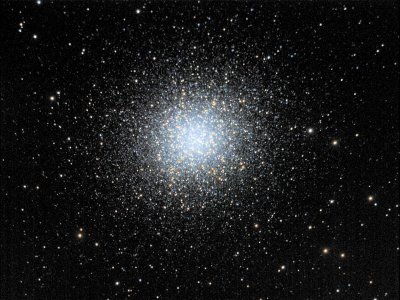
10-inch Newtonian, ST2000XM, 21:15:12:11 M13 is one of the biggest and brightest globular clusters, especially for those in the northern latitudes, and a favorite for observers on summer nights. It can be seen as a hazy patch in binoculars or a finderscope, and shows more and more resolution into individual stars as larger telescopes are used. |
|
|
|
|
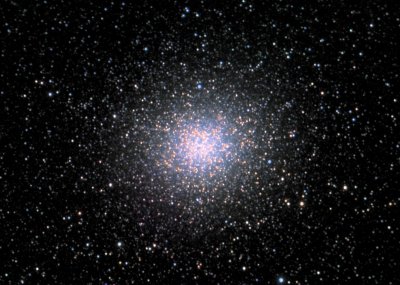
Meade 2045D, ST2000XM, 48:32:28:26 minutes, 42' x 59' This magnificent globular cluster is perhaps THE favorite target at the Texas Star Party. Most attendees make sure to take at least one look every year, even if they have been observing it for 20 years. There is no other cluster which can compare. At first glance, it may appear that M13, above, is similar but this field is approximately twice as wide and high! It is not easy to get a decent image, however, since it never gets more than 13 degrees above the TSP horizon. Seeing can be a real problem but I got fairly lucky the night this image was made. |
|
|
|
|
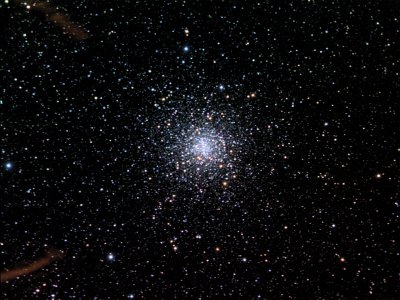 NGC 6121 (M4) Meade 2045D, ST2000XM, 24:16:12:12 minutes, 46' x 62' M4 is one of the half dozen or so largest and brightest globular clusters. Comparing it with NGC 5139 emphasizes how extraordinary 5139 is. It dwarfs M4 and no other globular does that. This is another image from the 2009 TSP. I'm not sure what the fingers of nebulosity(?) entering the field in the NE and SE corners really are, but I doubt that they are "real". They were not caused by frost or dewing but are probably some kind of reflection from Antares, approximately 50' beyond the edge of the field. Faint nebulosity from IC 4604, which surrounds Antares, reaches almost to M4 but all images I've found indicate it is extremely thin and diffuse in this area. I'm fairly certain it has no structures with this kind of contrast in the field. But I decided not to crop them out just to show the kind of things which show up in images. |
|
|
|
|
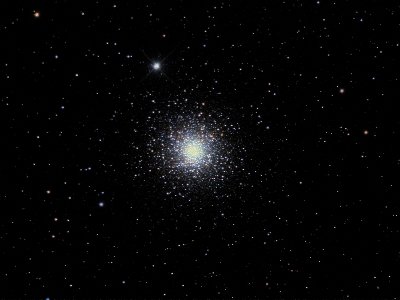 M15 (NGC 7078) 10-inch Newtonian, ST2000XM, 22:24:18:18 minutes M15 is a very bright (6.0 magnitude), very concentrated globular cluster. It has one of the most densely packed cores of any Milky Way globular. |
|
|
|
|
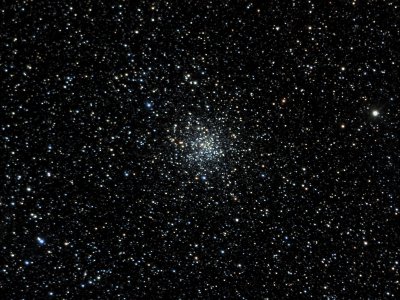 10-inch Newtonian, ST2000XM, 20:20:20:20 minutes The globular cluster Messier 71 is resolvable all the way to the core. It has an attractive mix of blue, yellow, and orange stars, and is seen against the background of the Milky Way. |
|

 |
|
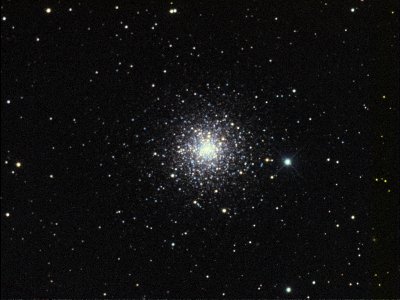 10-inch Newtonian, ST2000XM, 20:14:14:14 minutes, 20.9' x 27' Messier 30 is large, bright, and
very concentrated. It is very difficult to resolve the core.
This image replaces a mediocre one that was on the site previously.
It has smaller, crisper stars and shows more resolution to the core. |
|

 |
|
|
NGC 6656 (M22) 10-inch Newtonian, ST2000XM, 34:22:20:20 minutes M22 is large, bright, and resolvable to the core. It has an attractive mix of star colors. It ranks second behind M13 for the brightest globular visible from mid-northern latitudes. It is also one of the nearest. Images made before and after my tube replacement were merged to produce this image, so it still shows traces of the defects typical of my older images. |
|


|
|
|
NGC 6809 (M55) 10-inch Newtonian, ST2000XM, 10:10:10:10 minutes M55 is larger than M22 but is much less concentrated. It is even more easily resolved and gives the appearance, at least, of being resolvable visually in a moderate size scope. This image is a reprocessing of my previous data, to improve the color balance. |
|

 |
|
|
NGC7089 (M2) 10-inch Newtonian, ST2000XM, 10:10:10:10 minutes M2 is an extremely concentrated cluster. It is very hard to avoid over-exposing the core, and even harder to resolve it.
|
|

 |
|
 |