 |
Open Clusters |
|
|
By Messier Number
M11,
M21,
M23, M29,
M34,
M35,
M36,
M37,
M38,
M39,
M41,
M44,
M45,
M46,
M47,
M48,
M50, M52,
M52 (WF),
M67,
M67(WF),
M73, By NGC Number
206, 381,
457,
581, 654,
663, 663 (WF),
752, 869_and_884,
1662, 1746,
1912,
1960,
2099,
2158, 2158
(WF), 2168, 2243, 2264, By Other Catalog Number or Designation
Beehive,
Berkeley
6, Berkeley 10, Berkeley 11, Berkeley 17,
Berkeley 18,
Berkeley 58, Berkeley 68,
Christmas Tree,
Collinder 105,
|
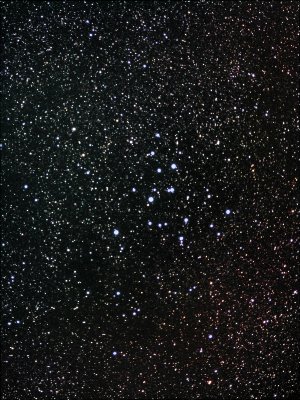
Astrotech AT66, ST2000XM, 24/20/10/10 M39 is a large, bright, loose open cluster. It contains 30+ stars in a diameter of 31'. It is only 200 to 300 million years old, so most of the stars are still burning hydrogen and are still on the main sequence. It is one of the nearest Messier objects to Earth. It can be seen with the naked eye in a dark sky and is an excellent binocular object in any sky. M39 has an apparent size slightly larger than the full Moon. This is another image from my yard. |
|

 |
|
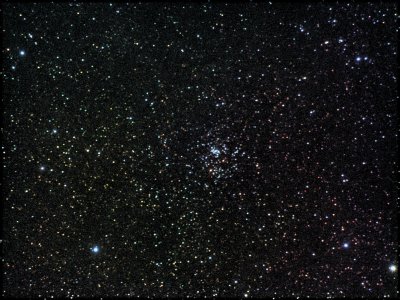
Celestron CG 9 1/4, ST2000XM, 60/20/20/20 NGC 6756 is a small open cluster in Aquila. It is 4.0' in diameter and contains about 40 stars. There is not a lot of information available on this one. It is just a pretty little group. This image was done from my yard in The Woodlands, TX. |
|

 |
|
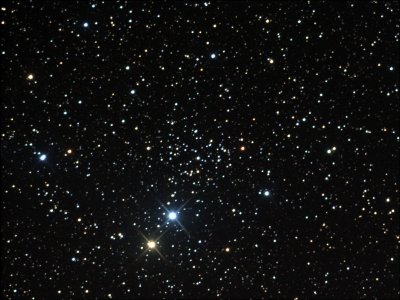
10-inch Newtonian, ST2000XM, 30/10/10/10 Clyde Tombaugh, the discoverer of Pluto, identified five open clusters during his search of plates from the Lowell astrograph. Later, one of them was found to be a duplicate discovery of IC 166. The first two of his list are shown here, and below, and IC 166 was imaged earlier. Tombaugh 1 includes 45 stars in a 5' diameter.owell |
|

 |
|
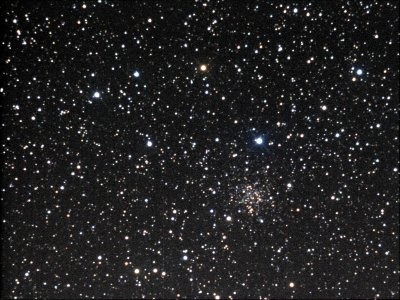
10-inch Newtonian, ST2000XM, 30/10/10/10 See Tombaugh 1 above. Tombaugh 2 is considerably denser, with 50 stars in a 3.0' diameter. |
|

 |
|
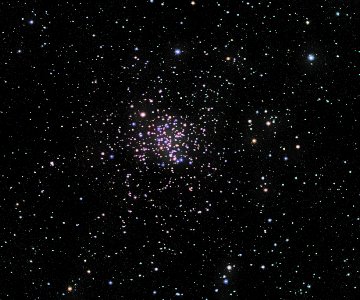
10-inch Newtonian, ST2000XM, 30/12/12/12 I have previously made a wide-field image of M67 with my AT-66 refractor. You can see that one here. It is actually a prettier image but does not show as much detail. M67 is a large, rich open cluster, containing about 500 stars in a diameter of 29'. A little of that area extends beyond the boundaries of this field. M67 is unusual in a number of ways, being one of the oldest open clusters known and being located a large distance from the galactic plane. Open clusters are generally located in the plane of the Milky Way. |
|

 |
|
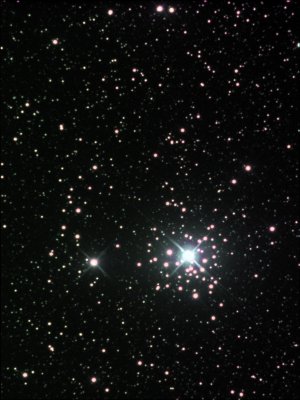
10-inch Newtonian, ST2000XM, 25/10/10/10 NGC 2362 is an unusual open cluster. I can not remember any with so many bright stars of similar brightness. The brightest member is tau Canis Major, a multiple star consisting of at least 7 components. The cluster is both young and massive. It is generally described as consisting of about 60 stars, but recent studies have identified several hundred low mass stars within its boundary. None of these show up in my image. |
|

 |
|
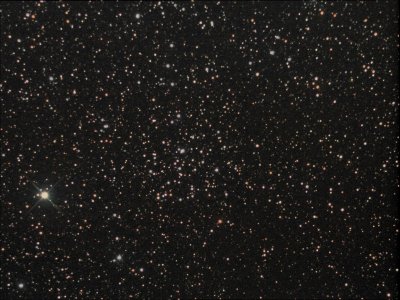
10-inch Newtonian, ST2000XM, 21/7/7/7 Like NGC 7243 below, this object has been suspected of not being a real cluster. However, a 1988 study confirmed that it is a cluster with 50 to 60 members. It certainly has more of the visual appearance of a cluster. |
|

 |
|
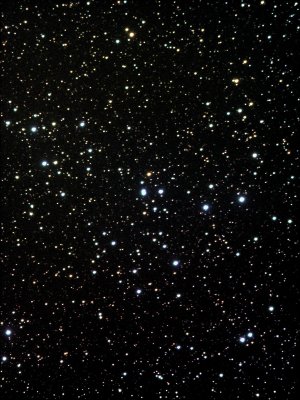
10-inch Newtonian, ST2000XM, 16/16/16 7243 is a very young cluster, only about 1 million years old, if it is in fact a cluster. A study in 1999 by Braun, Geffert, and Rosenbaum determined that neither the color magnitude diagram nor the proper motions of the stars in the region demonstrated the existence of a cluster. Their conclusion was that any cluster consisted of only a few stars. |
|

 |
|
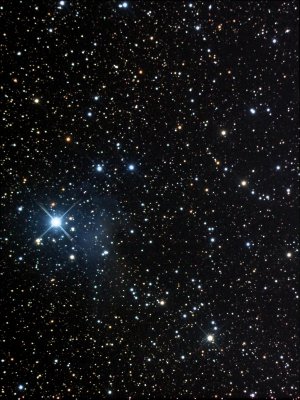
10-inch Newtonian, ST2000XM, 48/16/16/16 IC 5076 is the diffuse nebula located next to the bright star at the left of the field. NGC 6991 is a very sparse open cluster occupying most of the field, even running out a little bit on the right. The cluster consists of 35 stars in a 25' diameter. Megastar describes IC 5076 as an emission nebula, but the color and proximity to the bright star (SAO 50246) make me think it is a reflection nebula instead. Simbad does describe it as a reflection nebula. |
|

 |
|
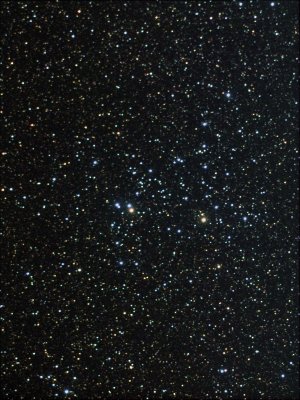
10-inch Newtonian, ST2000XM, 21/7/7/7 NGC 6709 is a fairly unimpressive open cluster in Aquila, although one observer calls it the finest open cluster in that constellation. It includes about 40 stars in a 13.0' diameter, but another reference puts the membership at 110 stars. It does not really stand out from the rich background in this image. It is probably a better target for visual observation than for imaging. |
|

 |
|
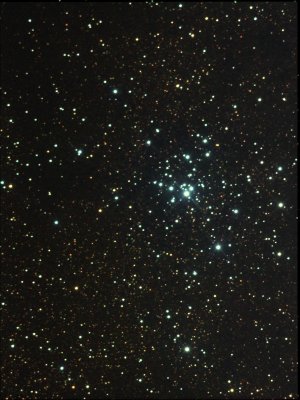
10-inch Newtonian, ST2000XM, 24/8/8/8 Messier 21 is a bright but fairly sparse open cluster in Sagittarius. It is located about 39' NE of the beautiful nebula M20, the Trifid. It contains about 57 or 70 stars (depending on the source) in a 13.0' diameter. It is a young cluster and star formation is still taking place. |
|

 |
|
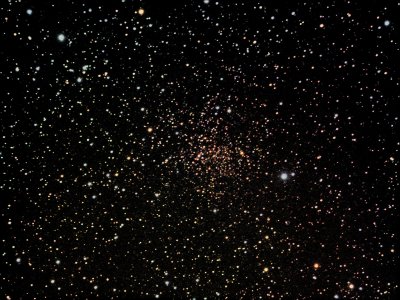
Celestron CG 9 1/4, ST2000XM, 44/16/16/16 This is another image from my home in The Woodlands, TX. IC 166 is s very rich open cluster, with 120 stars in a 4.5' diameter, according to Megastar. However, Archinal puts the diameter at 8.0', which seems more consistent with this image. In any case, it is a very pretty one. Clyde Tombaugh had put this one on his list of open clusters as number 3, but then discovered it was a duplicate. |
|

 |
|
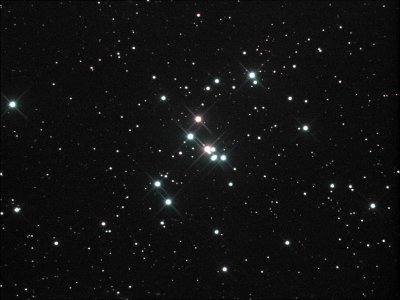
10-inch Newtonian, ST2000XM, 22:10:10:10 NGC 1662 is a bright, but sparse, open cluster. It includes 35 stars within a diameter of 20', and has a integrated magnitude of 6.4. If you study the Full-Size image carefully, you can find well over 100 tiny background galaxies. |
|

 ` ` |
|
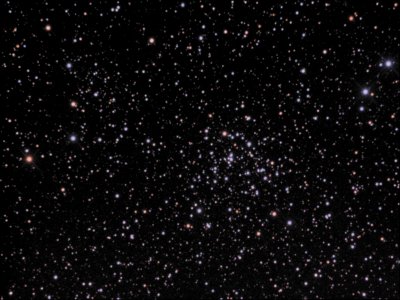
10-inch Newtonian, ST2000XM, 24:6:6:6 NGC 2421 is the larger and more obvious cluster just right and slightly below center. Czernik 31 is the faint sparse cluster occupying most of the upper left quarter or the image. 2421 contains 70 stars in a 10' diameter. Czernik 31 is only slightly smaller, with a 9' diameter and includes 40 stars. Both clusters contain a lot of colorful stars. They are probably great visual targets. |
|

 ` ` |
|
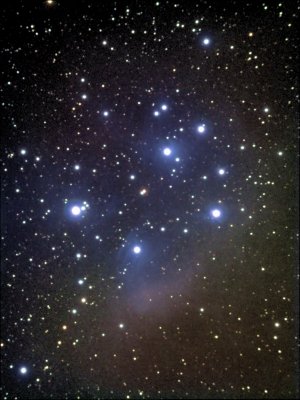
Astro-Tech AT66ED, ST2000XM, 148:48:48:48 M45 was imaged with my AT66 in my yard in The Woodlands, TX. So, even though the total exposure was almost 5 hours, it is a barely acceptable image. A dark sky image would show much more nebulosity, and more detail in the nebulosity, than seen here. M45 really does not have an NGC number. The nebula is NGC 1432 and 1435. The cluster is the Pleiades, or Seven Sisters, while M45 is the whole thing. Messier was unaware of the nebulosity when he cataloged it. The first known identification of nebulosity was in 1859, by Ernst Tempel at the Vienna Observatory with a 4-inch refractor. The nebulosity in the lower right corner of the image contains a lot of dust, giving it the brownish color. It is often not seen in shorter exposures but is obvious in almost any wide-field image of the area. |
|

 ` ` |
|
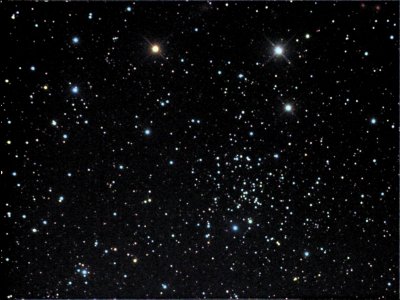
10-inch Newtonian, ST2000XM, 48:16:16:16 The Berkeley clusters consist of 103 open clusters (and one globular) cataloged in 1962 by two astronomers from University of California, Berkley. They are generally faint, many small and sparse, but others are very rich and interesting. This one is certainly rarely imaged. The only image I turned up on a Google search was the DSS image. The cluster is just below and right of center, with a diameter of 12.0'. It is described as containing 50 stars. The little cluster/asterism near the bottom to the left is actually more interesting looking. Right up against the top edge of the field, nearly midway between the two brightest stars, is some faint fuzz which is UGCA 81. |
|

 |
|
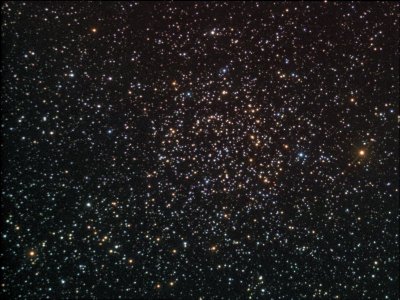
10-inch Newtonian, ST2000XM, 30:10:10:10 NGC 7789 is a large, fairly rich open cluster with a lot of colorful stars. It was discovered by Caroline Herschel. It is listed as containing 300 stars, with a diameter of 15.0', and a magnitude 6.7 |
|

 |
|
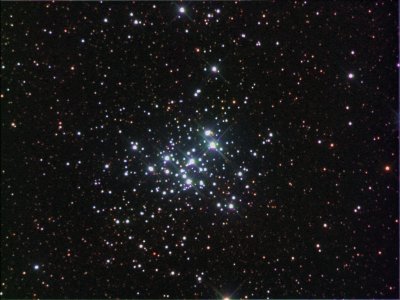
10-inch Newtonian, ST2000XM, 40:10:10:10 NGC 6231 is a bright, loose cluster consisting of 93 stars in a 14.0' diameter. It is a far southern object, -41 d, 50 m. Zeta1 Sco is a member of the cluster: Zeta2, the brightest star in the field, is not a cluster member. The cluster contains three Wolf-Rayet stars. |
|

 |
|
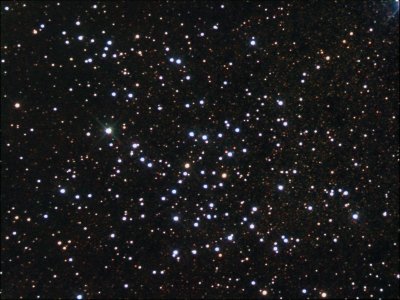
10-inch Newtonian, ST2000XM, 24:12:12:12 M23 is a very large and very loose open cluster. The boundary extends several minutes below the bottom of this field, but there do not appear to be many members in this area. It consists of about 150 stars in a diameter of 27.0'. The Milky Way does not, of course, have a hard boundary but this cluster lies right at the edge of the generally accepted boundary. A careful study of one of the larger images shows a host of very faint stars on the right half. These are not, in general, cluster members but instead are faint MW background stars. There are far more of them than cluster members. |
|

 |
|
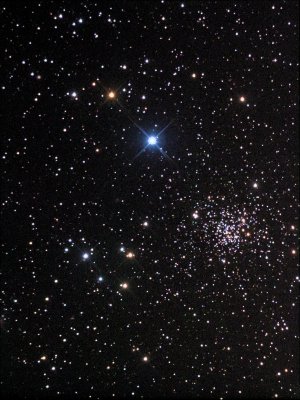
10-inch Newtonian, ST2000XM, 30:10:10:10 NGC 2243 is a pretty open cluster in Canis Major. It contains about 100 stars in a 5.0' diameter, which makes is fairly dense. It is an old cluster, estimated at about 3.5 t0 4 billion years. To me, the most interesting thing about this cluster is the similarity of all the stars, both in brightness and color. Almost all are white, with a much smaller range of brightness than I've observed in most open clusters. This is probably related to the age, with most of the original larger and brighter stars having already reached the end of life. |
|

 |
|
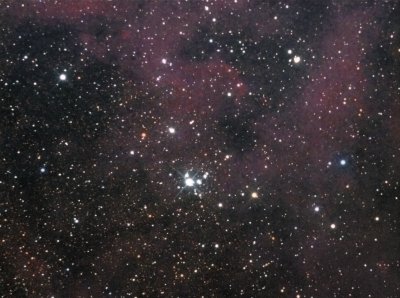 NGC 6604 and Sharpless 2-54 10-inch Newtonian, ST2000XM, 30(+ 30 h-alpha):10:10:10 NGC 6604 is the small (6' diameter), bright open cluster at the center of the field. The stars are concentrated toward the bottom edge of the cluster. It contains 105 stars. The nebulosity throughout the field is just a small part of Sharpless 2-54. This object is huge, 144' x 78', and quite irregular. The cluster is located near the southeast end of the nebulosity. |
|

 |
|
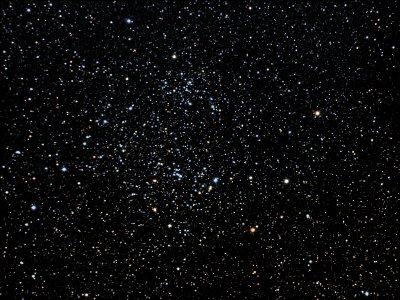
10-inch Newtonian, ST2000XM, 25:8:8:8 NGC 6755 is an open cluster with a diameter of 14' and a magnitude of 7.7. It looks like two two separate clusters but that is apparently not the case. Other than the fact that it contains about 100 stars, there is not much information available. |
|

 |
|
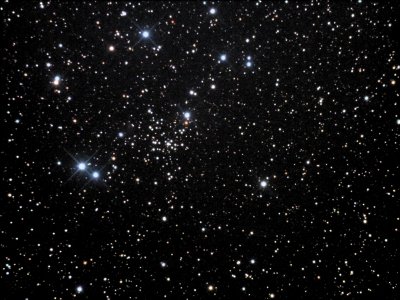
10-inch Newtonian, ST2000XM, 30:10:10:10 Berkeley 11 is a small but attractive open cluster. It is located just left of center. It includes 35 stars in a 5.0' diameter. None of the brighter stars are cluster members. Near the left edge of the cluster, you can locate (in the larger images) a tiny fuzzy spot which is Sharpless 2-213. The Sharpless catalog says that it "may be a very faint Stromgren sphere around a B4 class star." A Stromgren sphere is a shell of hydrogen expelled by a rapidly evolving star -- the Rosette Nebula is one of the largest and best known examples. |
|

 |
|
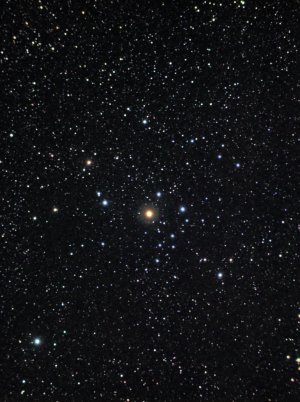
Astro-Tech AT66ED, ST2000XM, 80:32:32:32, 73' x 98' 2451 is a large (45' diameter), sparse cluster. It contains 40 members. At almost -38 degrees, it is seldom imaged from most of the U.S. By the time my image was finished, the telescope was pointing only 4 degrees above the horizon. The bright orange star in the center is c Puppis. It has a magnitude of 3.62. |
|

 |
|
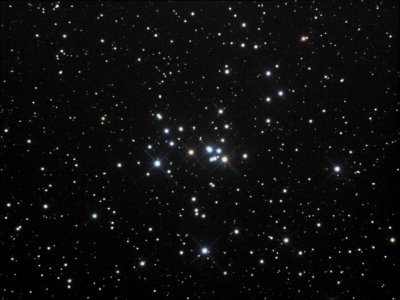
10-inch Newtonian, ST2000XM, 24:8:8:8 2281 is a sparse but bright open cluster, consisting of 30 stars in a diameter of 14'. Other than a variety of doubles for observers wishing to test their equipment, and a nice range of star colors, there is not a lot of interest here. |
|

 |
|
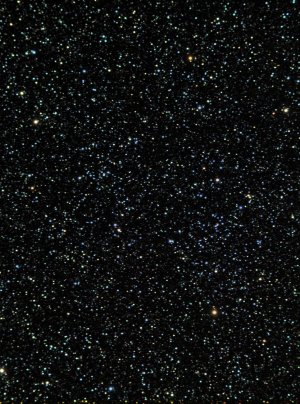 NGC 2428, 2430, and Ru 151 Astro-Tech AT66ED, ST2000XM, 24:8:8:8, 72' x 97' This is a rather uninteresting trio of open clusters. They barely show up against the field stars. NGC 2428 is the slightly richer area just right and below center, and Ru 151 is similar and very slightly above and left of center. NGC 2430 is supposedly just above 2428 but I see nothing that I can identify as a cluster. This is not too surprising, as it contains only 20 stars in a 7.5' diameter and Megastar lists the class as "asterism?" None of them is rich, with 2428 listed as containing 50 stars in a 13' diameter and Ru 151 with 30 in a 14' diameter. By these measures, 2430 is actually the richest of the three even though it is the least obvious. |
|

 |
|
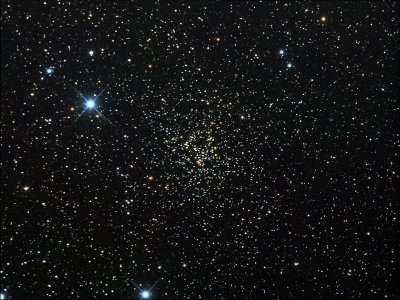
10-inch Newtonian, ST2000XM, 24:10:10:10 NGC 6819 is a compact and distant open cluster. Megastar, using Lynga as the reference, lists it as containing 929 members. Other sources list the membership between 150 and 2500 stars. The magnitude cut-offs for the surveys seem to produce the differences. Numbers at the high end of the range are more likely. My image is not very deep, and was taken under marginal conditions, so it does not come close to showing the entire membership. It would be well worth investing several hours of exposure on this cluster. Regardless, it is a rich and attractive object, one of the best open clusters available. |
|

 |
|
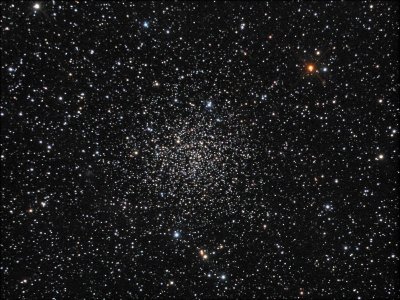
10-inch Newtonian, ST2000XM, 30:10:10:10 NGC 6791 is a very rich open cluster. Megastar lists the membership as 255 stars but that is obviously too low, and a 2011 study determined a membership of 4800. This cluster is unusual in a number of ways. It appears to be very old and yet very metal rich; these two characteristics don't go together. It also has two groups of white dwarfs whose ages do not seem consistent with the age of the cluster. As a result of all this, it is one of the most studied open clusters. It is a beautiful cluster for imagers and visual observers with a wide range of telescopes. There are also a number of small galaxies in the field. See how many you can find in the full size image. |
|

 |
|
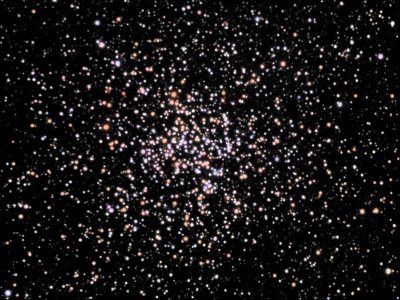
10-inch Newtonian, ST2000XM, 24:8:8:8 NGC 2477 is a large, rich southern cluster containing about 160 to 300 stars -- the sources differ. The listed diameter is 27'. It fits within this image in the E-W (left to right) direction but is slightly cut off at the top and bottom. It is mentioned as containing a carbon star but I have not been able to find anything that is extraordinarily red. If someone spots it, please let me know. This cluster is at declination -39 32. At this low elevation, the seeing was perhaps the worst I've ever seen. Getting focus was a real challenge and even with decent focus, the stars were very bloated. |
|

 |
|
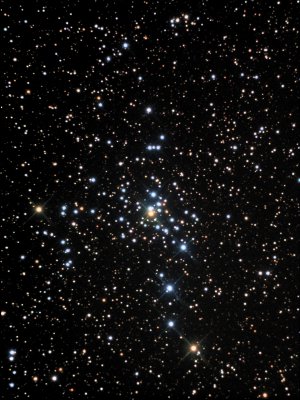
10-inch Newtonian, ST2000XM, 36:12:12:12 NGC 2301 is nice open cluster with 80 members in a 12' diameter, although some studies indicate that the area and membership are considerably larger. It appears very elongated in the N-S direction. It contains a large number of variables. |
|

 |
|
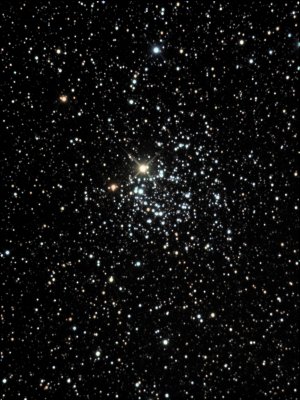
10-inch Newtonian, ST2000XM, 36:12:12:12 Like NGC 2301 above, NGC 2439 is also credited with containing 80 members but, since the diameter is 10' versus 12', it appears richer. NGC 2439 is not imaged as often as many similar clusters because of its low declination, almost 32 degrees south. It is a young cluster but otherwise has not been investigated very much. |
|

 |
|
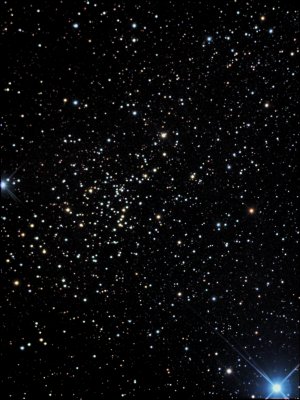
10-inch Newtonian, ST2000XM, 30:10:10:10 NGC 7762 is a 10th magnitude open cluster, containing about 40 stars in an area about 11.0' in diameter. The cluster is offset a bit to the left in this image (to get a brighter guide star) but falls comfortably within the field. It is a colorful cluster. To me, it seems like the fainter stars tend to be blue and the brighter ones white or orange. |
|

 |
|
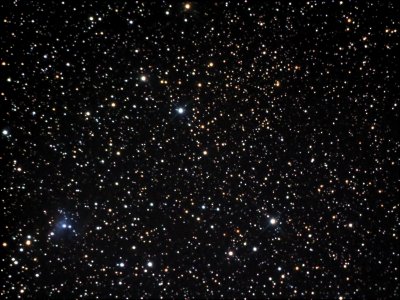
10-inch Newtonian, ST2000XM, 30:10:10:10 Berkeley 68 is a faint, sparse cluster difficult to pick out from the bright stellar surroundings. It contains 60 stars in a 12' diameter. The camera field of view is 21.7' x 28.9'. The cluster is almost perfectly centered so it occupies a bit over half of the field top-to-bottom and just over 40% of the side-to-side field. Even in this area, most of the stars are foreground stars. It is primarily the faintest stars that are cluster members. Perhaps the most interesting feature of this image is the small reflection nebula toward the lower left corner. It does not show up on Megastar, so I had dreams of discovery as I was acquiring the image. Alas, this object has been known for many years and is listed as GN 4.41.8 in the "Atlas of Galactic Nebulae" by T. Neckel and H. Vehrenberg. |
|

 |
|
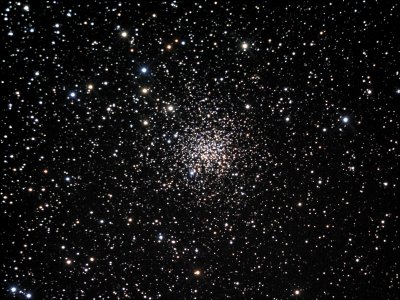
10-inch Newtonian, ST2000XM, 42:14:14:14 NGC 2158 is a spectacular open cluster in a larger telescope. It contains 973 stars in a 5.0' diameter. The color is very yellowish, partially due to age, but more because of dust between us and the cluster. It is often observed in the same field with M35; for an wide-field image showing them together, click this link. NGC 2158 is the little yellow cluster. It is one of the most distant open clusters in our Milky Way galaxy. It has been theorized that it failed to become a globular cluster only because it formed in a region that was deficient in mass. |
|

 |
|
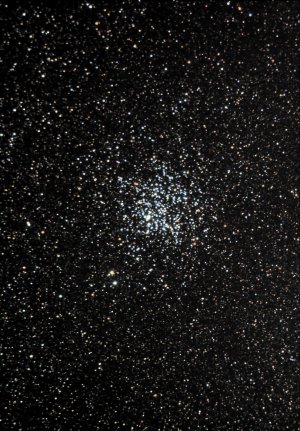
10-inch Newtonian, ST2000XM, 25:10:7:9 M11 is one of the brightest and richest open clusters in our galaxy. It contains about 2900 stars. It is known as the Wild Duck Cluster, but I have never been able to see a resemblance. I've always found it a fairly colorless cluster, made up mostly of white or bluish white stars, and a few creamy ones. |
|

 |
|
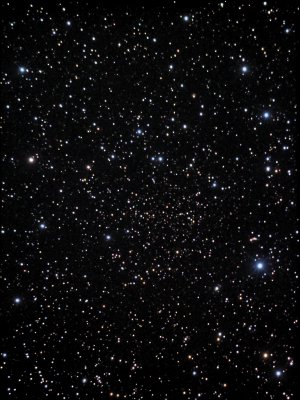
10-inch Newtonian, ST2000XM, 36:12:12:12 Your first reaction is probably that this is not an impressive cluster. It certainly isn't bright. But if you look past the foreground stars, preferably on the Half or Full size images, you will find a rich cluster of faint stars. They are mostly yellow, which implies that there is a lot of dust and distance between us and the cluster. This cluster is listed as including 100 stars in a 13' diameter, which makes it richer than M35, 41, or 67, clusters which we think of as fairly rich. The members are just so faint. This cluster currently holds the record as the oldest cluster in our Milky Way. The Berkeley clusters consist of 103 open clusters (and one globular) cataloged in 1962 by two astronomers from University of California, Berkley. They are generally faint, many small and sparse, but others are very rich and interesting. This one, and Berkley 18 below, are certainly rarely imaged. A Google search turned up only two images of this one, and none of Berkeley 18. |
|

 |
|
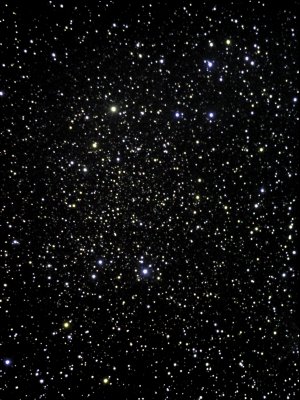
10-inch Newtonian, ST2000XM, 36:12:12:12 This cluster is more obvious than Berkeley 17 above, mostly because it is brighter. It is only slightly richer with its 300 stars spread over a diameter of 20'. The members also tend to be yellow, although to my eye a little less yellow than Berkeley 17. While I have found no distances for either cluster, this one is probably a bit closer. I have not found any other amateur images of this object. Many of the Berkeley clusters are shown in Megastar and Uranometria, but not all. There are plenty, however, to keep a dedicated imager or visual observer with a large scope busy for a long time. |
|

 |
|
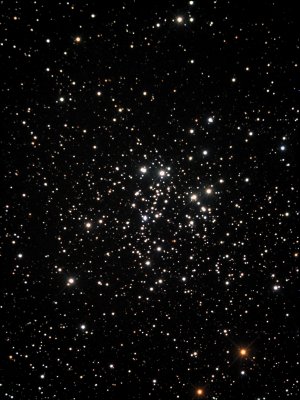
10-inch Newtonian, ST2000XM, 30:10:10:10 This is a pretty open cluster of approximately 80 stars. They generally range from white to very pale orange. The two bright, deep orange stars in the lower right are outside the accepted boundary of the cluster. The cluster is 16' in diameter. Previously, this cluster has been included in a wide-field image made with my AT66. That image can be seen here with NGC 663 in the lower right corner, and NGC 654, IC 166, Czernik 5, and Berkley 6 also in the field. |
|

 |
|
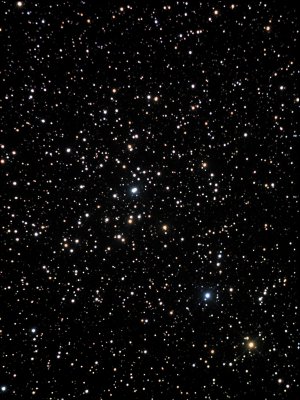
10-inch Newtonian, ST2000XM, 24:10:10:10 NGC 2423 is a very sparse cluster with only 40 stars in a 19' diameter. The cluster hardly stands out against the background. NGC 663, above, is much richer and more striking. NGC 2423's major claims to fame are that M47 is very nearby and can often be placed in the same view with a wide-field eyepiece, and that there is an exoplanet orbiting the star 2423-3. |
|

 |
|
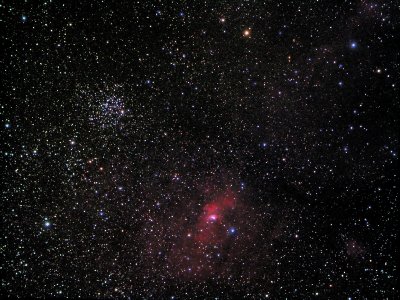 M52 (NGC 7654) and NGC 7635 Astro-Tech AT66ED, ST2000XM, 28(+28 H-a):12:12:12, 74' x 99' Images of both these objects made with my 10-inch can be seen elsewhere on this site. They, of course, show much more detail. I made this image while I was checking out my equipment for an upcoming star party and decided to include it primarily to show a perspective of the whole field. Discussions of M52 (on the Open Clusters page) and NGC 7635 (next object down) can be found with the more detailed images. Objects which don't show on those images include Czernik 43, a sparse cluster of 15 stars just below and left of M52, and Sharpless 2-159, a faint tuft of emission nebulosity near the lower right corner of the field. Also, some dark nebulosity weaves around the objects. This image was made from my back yard in The Woodlands, TX. While it does not compare with the dark sky images through the 10-inch, it does show that quite a bit can be captured with a tiny scope in light-polluted conditions. |
|


 |
|
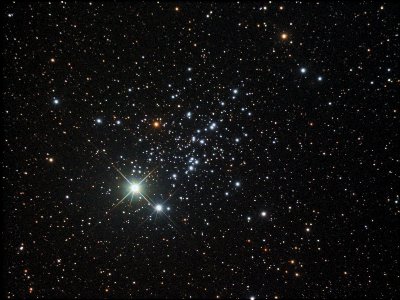
10-inch Newtonian, ST2000XM, 30:10:10:10 This cluster has been given a number of common names -- ET cluster, Owl cluster, Kachina Doll cluster, and others. It is easier to see why these names have been given if you look at the cluster "upside down", which is how it would be seen in an inverting telescope. Imagine the two brightest stars, Phi-1 and Phi-2 Cassiopeia, as the "eyes". These stars show an interesting color contrast, with Phi-1 having a creamy color and Phi-2 white or bluish-white. The cluster has a diameter of 13.0' and contains about 80 stars. The very red-orange star a few minutes above the Phi-1, Phi-2 pair is SAO 22188. It is spectral class M2, which means that it a very cool star, about half the surface temperature of our Sun. |
|

 |
|
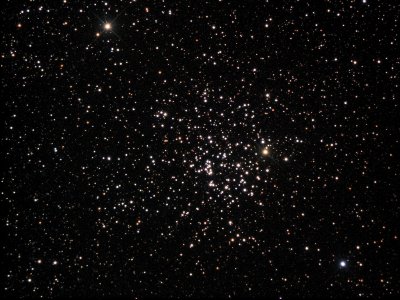
10-inch Newtonian, ST2000XM, 30:10:10:10 M52 is an open cluster with a diameter of 12.0', containing between 100 and 200 stars, depending of which study you want to rely on. The bright orange star on the right side of the cluster is not a member. The distance to this cluster is quite uncertain because it is heavily obscured by intervening dust. M52 is a fairly easy binocular object in clear dark skies. |
|

 |
|
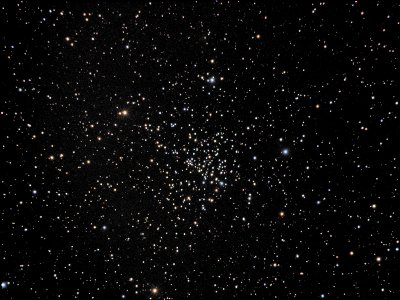
10-inch Newtonian, ST2000XM, 30:10:10:10 NGC 6939 is an attractive but undistinguished open cluster. It contains about 80 stars in a diameter of 7.0' Almost all images posted of this cluster include it in a wide field image with the beautiful galaxy NGC 6946 (Arp 29), about 39' southwest.
|
|
|
|
|
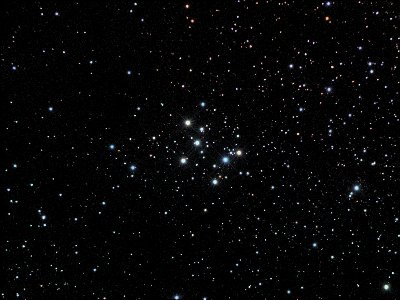
10-inch Newtonian, ST2000XM, 24:8:8:8 Messier 29 is a small (6.0' diameter), bright open cluster including about 50 stars. The eight brightest stars dominate the view and the numerous fainter stars seem to fade into the background. It is not very colorful. It lies behind a lot of dust, not seen in this image, and would be almost three magnitudes brighter if not dimmed by this dust. |
|
|
|
|
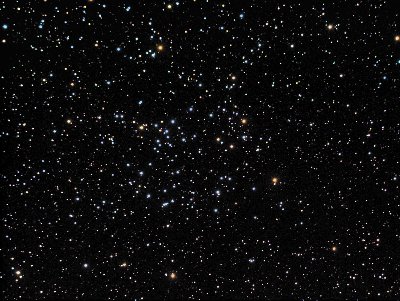
10-inch Newtonian, ST2000XM, 20:7:7:7 NGC 6811 is a sparse open cluster located in the Cygnus Milky Way. It does not stand out strongly from the background. It consists of about 70 stars in a 12>0' diameter. The stars in, and around, the cluster are fairly colorful. While not an impressive cluster, this would be a wonderful target for a visual double star observer with a large scope. There are enough doubles and multiples to fill a night of observing. An 8-inch would be the minimum objective and a 12-inch or more would be even better, because most of the primaries are in the 11 to 13 magnitude range, with the companions as faint as 16 magnitude. |
|
|
|
|
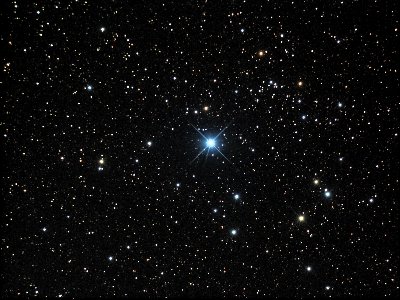
10-inch Newtonian, ST2000XM, 20:9:9:9 NGC 6885 is consists of 30 stars in a 18.0' diameter. That makes it a very sparse open cluster. The integrated magnitude is 8.1 -- the very bright star right in the center, 20 Vul, is not a cluster member. At magnitude 5.91, it is far brighter than the cluster. |
|
|
|
|
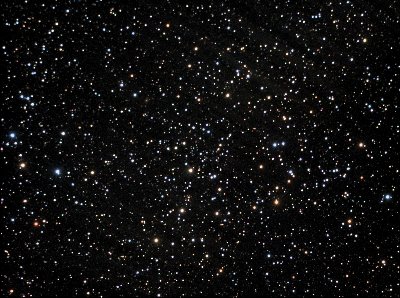
10-inch Newtonian, ST2000XM, 30:10:10:10 NGC 2354 is a large (20' diameter) loose open cluster. It almost fills this field from top to bottom, as the field is 21.7' high. Megastar lists it as containing about 100 stars. There are many times that number in the center 20' of the image but it is in a region on the fringes of the Milky Way, so there are lots of foreground and background stars involved. Some faint, tiny galaxies can be seen through the cluster. I believe that the streaks in the background are reflections from delta Canis Major, about 1.5 degrees to the SW. |
|

 |
|
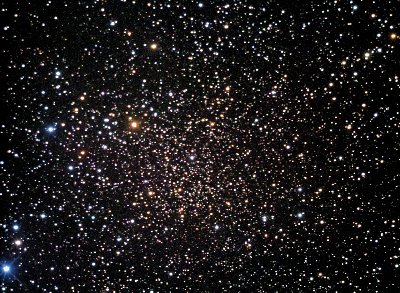
10-inch Newtonian, ST2000XM, 46:16:16:16 This is one of my favorite open clusters. It is a little below and slightly left of center, just below the triangle of brighter orange stars. Megastar credits it with 150 stars in a 12' diameter but I believe the number is well over 300. The generally yellow color is partially due to the age -- it is an old cluster -- but is more likely the result of viewing it through vast clouds of dust. The cluster is in (or behind) the nebula Sh2-273. The Christmas Tree Cluster and the Cone Nebula are part of this complex -- they are about a degree and a half away. The Christmas Tree is in a wide field image taken with my AT66 telescope and Trumpler 5 is included in that field. This image is far deeper. For a more delicate view, more like the visual impression in a very large telescope, click on the RGB button below. It also makes the nebulosity more obvious. |
|
 |
|
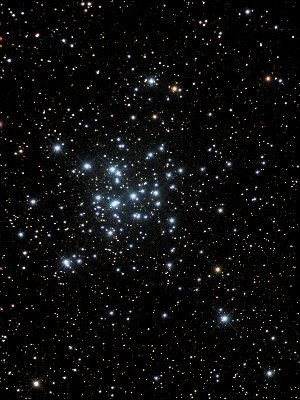
10-inch Newtonian, ST2000XM, 24:10:10:10 M36 is a bright open cluster in Auriga. It includes about 60 stars. Essentially all of the brighter ones are blue-white, B-type stars. It is one of the younger galactic clusters. There is nothing particularly interesting about this cluster, and my image is not at all outstanding, but I consider it one of the prettiest images I've taken. The mix of colors and brightness really catch the eye, and the network of diffraction spikes adds a special dimension. The Half Size image is the most attractive on my monitor, because it all fits on the screen.
|
|
|
|
|
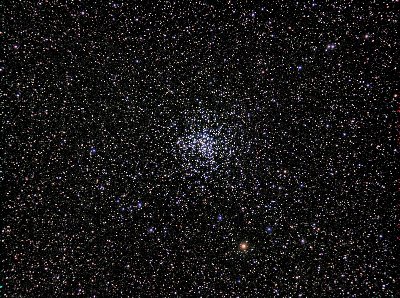
Astro-Tech AT66ED, ST2000XM, 60:20:20:20 minutes, 75' x 101' While M36 above is a very young cluster, M37 is a fairly old one. It shows a much wider range of star colors and lacks the concentration of young B-type stars. It has more than 150 members. But, since the diameter is almost twice as great as M36, the number of stars per square arc minute is actually less. The Half Size image is shown with my typical level of color saturation, and has a color balance that is close to "true color". I ramped up the saturation of the Full Size image to emphasize the deep red (garnet?) star very near the center of the cluster, and the intense blue stars which seem to be more concentrated in the outer fringes. Burnham refers to the red star as "a ruby on a field of diamonds" but I believe he is quoting an earlier observer. |
|
|
|
|
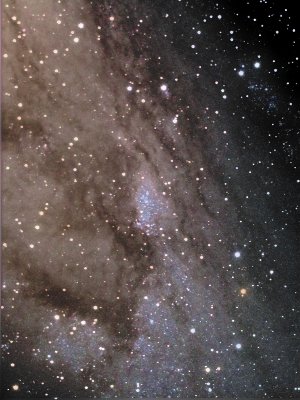
10-inch Newtonian, ST2000XM, 48:12:12:12 NGC 206, located right in the center of the image, is the brightest star cloud in M31, the Andromeda Galaxy. Almost everyone has seen it in wide field views on the whole galaxy but it is not often targeted for imaging itself. You can see it in my wide field image on the Galaxies page -- it is fairly subtle. It is similar to M24 in our own galaxy, but is larger, brighter, and younger. There are about 32 globular clusters in this image. I have tracked down about a third of them but it is really not worth the trouble. Even the best look like stars that are a bit out of focus, and most can't be distinguished from nearby stars. Although I'm sure this feature is well known, I had never noticed that the arm closest to the W (upper-right) edge consists almost entirely of bright, very blue, stars.
|
|
|
|
|
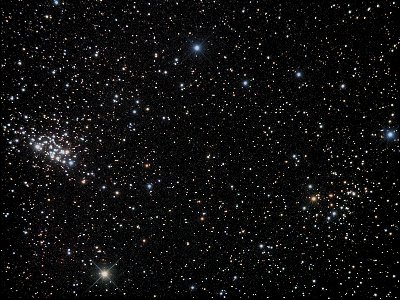
10-inch Newtonian, ST2000XM, 24:10:10:10 NGC 7510 is the brilliant open cluster near the left edge, while the sparse, faint cluster near the right edge is King 19. NGC 7510 includes about 60 stars within a 4' diameter while King 19 has 25 stars within a 6' diameter. It looks like 7510 is bleeding off the edge of the field, but it is not. The stars less than 2.5' from the edge are not considered part of the cluster. The structure of NGC 7510 is very unusual. To me, it looks like almost all of the stars are arranged into long, nearly parallel chains. It is a young cluster, with almost all of the stars being white. King 19 has the typical colors for an older, higher metallicity cluster. |
|
|
|
|
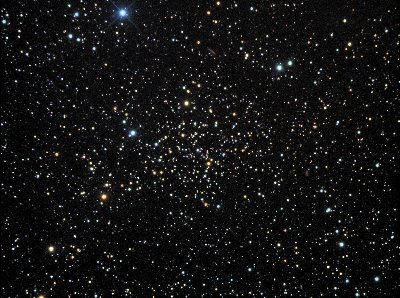
10-inch Newtonian, ST2000XM, 24:10:10:10 NGC 7142 is an interesting object. It is one of the oldest open clusters and contains about 100 stars. Because of reddening by interstellar dust, the age and distance have been difficult to establish with any certainty. For an old cluster, it contains a surprising number of blue stars (mostly very faint) which are believed to be "blue stragglers". A number of these can be found by studying the full size image. They are among the faintest stars visible. At the same time, note the unusual number of background galaxies visible within, and just outside, the cluster. These are in no way connected to the cluster but I haven't encountered this many in other open cluster images, especially ones this short. Wikipedia contains a fairly extensive discussion of NGC 7142 at http://en.wikipedia.org/wiki/NGC_7142. |
|
|
|
|
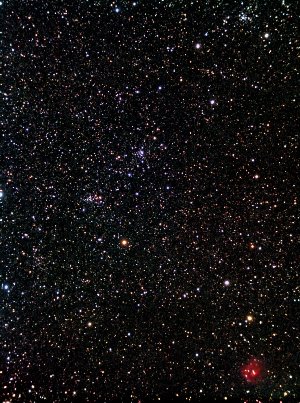
Astro-Tech AT66ED, ST2000XM, 40:(40 H-a):24:24:24 minutes, 101' x 74' This image contains six open clusters -- King 12, Harvard 21, Frolov 1, NGC 7788, NGC 7790, and Berkeley 58 -- and one emission nebula -- Sh2-168. All of the clusters except Frolov 1 are on a nearly straight line starting with King 12 at the top right and ending with Berkeley 58 near the left edge, about one-third of the field up from the bottom. Frolov 1 is left of the straight line, about 14' above and slightly to the left of NGC 7788. Originally, I had not properly identified it because the size listed in Megastar is much too small. Also, I had misidentified King 12 as Harvard 21 and had not spotted the real Harvard 21 at all. Neither Frolov 1 nor Harvard 21 are much to get excited about. My friend Dennis Webb came to my aid with some outstanding data mining, and got me on the right track. Sh2-168 is in the lower right corner. The image on the Half page has all of the objects marked and labeled, if you are having trouble finding them (like I did). The sizes of the circles approximately reflect the size of the objects but I did not make any effort to match them exactly, especially since a couple of them have no published diameters. This image was taken from my backyard in The Woodlands, TX. I took 40 minutes of H-alpha exposure, because Sh2-168 showed up very poorly in the luminance image, and blended it at a 15% level with the luminance. This had little effect on the stars and made Sh2-168 show up much better. |
|
|
|
|
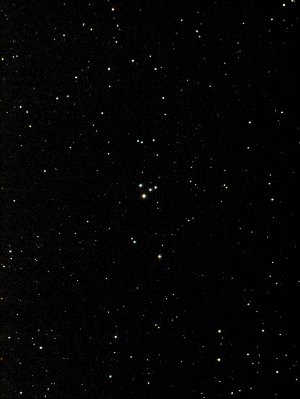
10-inch Newtonian, ST2000XM, 2:2:2:2 M73 is one of Messier's "mistakes". He correctly saw it as a tiny group of 4 stars but thought there was some nebulosity involved. Even the deepest modern images show no hint of nebulosity. I probably would never have bothered to image M73 except for a project by my astronomy club to do color images of all the Messier objects. You can see the result of our project at http://www.kellysky.net/jscas_messiers_draft_10x11.jpg. It is a large file and could take several minutes to load. And, while my images on this site are not copyrighted, this set of images is.
|
|
|
|
|
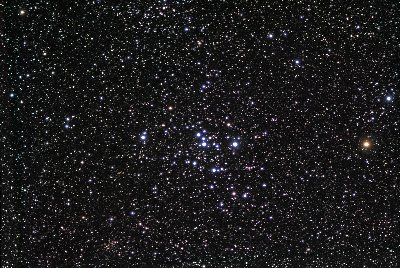
Astro-Tech AT66ED, ST2000XM, 32:16:16:16 minutes, 67' x 101' M47 is a coarse open cluster including about 30 bright stars. Also shown are the tiny cluster NGC 2425 (also about 30 stars), near the bottom of the field, and the large loose group NGC 2423 (with 40 stars), at the top of the field. A little of 2423 is cut off at the edge. The RGB images were made at my home in The Woodlands, TX, and the luminosity was done at Fort McKavett, TX, during my club's spring star party. |
|
|
|
|
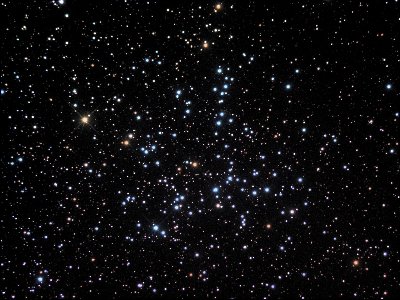
10-inch Newtonian, ST2000XM, 28:16:16:16 This large, bright cluster is 21' in diameter and just fits within the field. It contains about 100 stars. It has a high concentration of blue stars and some yellow type G giants, giving it a pleasing contrast of colors. The brightest member, the yellow giant about halfway to the left side of the field, is magnitude 7.9. According to Burnham, "our Sun would appear as a star of magnitude 15.3 at the distance of M38". This is almost 1700 times fainter. |
|
|
|
|
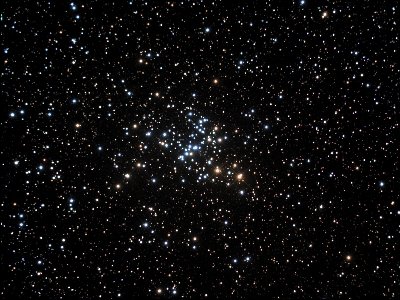
10-inch Newtonian, ST2000XM, 28:16:16:16 This bright, beautiful cluster contains about 80 stars. It appears to be concentrated toward the center of the field, but it actually fills the field from top to bottom and almost from side to side. Its diameter is listed at 22' and my field is only 21.7' in the short direction. |
|
|
|
|
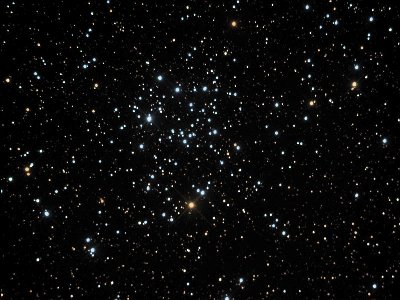
10-inch Newtonian, ST2000XM, 28:16:16:16 This image was made with the same scope, camera, and exposure time as M38 and M93, so they can be directly compared. While M50 appears larger than M93 and about the same size as M38, is is actually significantly smaller, only 16' in diameter. We are fooled by the area of brighter stars and tend not to notice the fainter outer members. M50 has about the same number of stars as M93 and slightly less than M38. It appears to have a lower percentage of yellow/orange stars than the other two clusters, being predominately blue or white. |
|
|
|
|
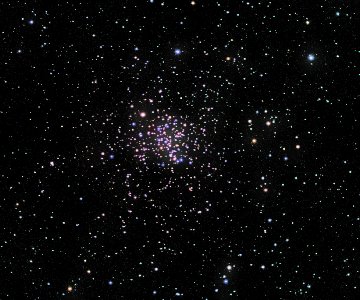
Astro-Tech AT66ED, ST2000XM, 48:16:12:16 minutes, 76' x 100' M67 is a large, rich open cluster, containing about 500 stars in a diameter of 29'. It is unusual in a number of ways, being one of the oldest open clusters known and being located a large distance from the galactic plane. Open clusters are generally located in the plane of the Milky Way. This image was done at my home in The Woodlands, TX. |
|
|
|
|
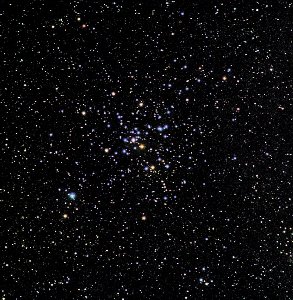
Astro-Tech AT66ED, ST2000XM, 16:16:16:16 minutes, 73' x 72' M41 is a bright beautiful cluster, 38' in diameter and containing about 80 stars. It is located about 4 degrees south of Sirius. This image had to be significantly cropped because it was shot over two nights, and I did not line it up properly the second night. It was made in The Woodlands. |
|
|
|
|
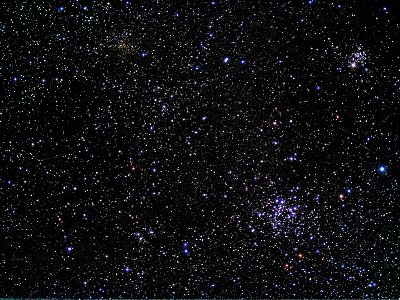
Astro-Tech AT66ED, ST2000XM, 44:20:20:20, 75' x 101' This field has an open cluster for everyone! The large, bright cluster toward the lower right is NGC 663, the small, bright one in the upper right is NGC 654, and the much fainter, very yellow cluster near the top of the field about one-quarter of the way from the left edge is IC 166. IC 166 has the largest population, almost as many members as 663 and 654 combined, but is much more distant and dimmed by intervening dust. There are two more clusters that are hard to see in this thumbnail. Very near the left edge, about midway between top and bottom, is a tiny cluster of about 10 stars, Czernik 5. And midway between the left edge and NGC 663, about even with the south side of 663, is an irregular cluster of about 20 stars cataloged as Berkeley 6. Most of the stars in Berk 6 form an irregular band running from NE to SW. Neither of these last two are easy to recognize as clusters. They seem to stand out best in the half size image. This image was taken in The Woodlands, TX |
|
|
|
|
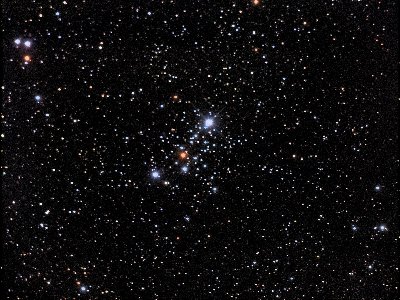
10-inch Newtonian, ST2000XM, 24:16:16:16 M103 is a bright but sparse open cluster in Cassiopeia. It only contains about 25 stars. It was the last entry in Messier's original catalog but several others have been added later. This is one of my poorer images. It was taken in bright moonlight. I was just looking for something I could image while I tried out a new separate guidescope arrangement. As you can see, neither the focus nor the guiding were good, and it is very noisy because of the moonlight. |
|
|
|
|
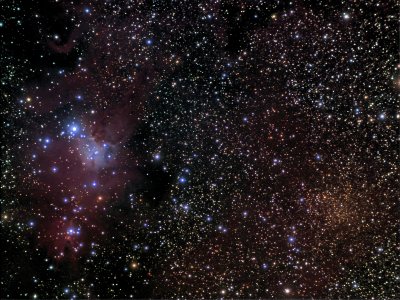 Christmas Tree Cluster (NGC 2264), Cone, SH2-273, and Trumpler 5 Astro-Tech AT66ED, ST2000XM, 60:32:28:28 minutes, 76' x 102' This is a beautiful and jam-packed field, and is my first image using the AT66 at my observatory. The bright nebulosity seen throughout the field is SH2-273. The Christmas Tree cluster is on the left, "upside down" in this N up presentation. The brightest star is the trunk and the little group at the other end is the "star" at the top. The Cone Nebula is at the bottom left of the field, just below the "star" on the tree. It is very small in this thumbnail and not large even in the full size image. It is an object that I need to image next year with my 10-inch. Trumpler 5, in the lower right, is a spectacular open cluster, strongly reddened (or yellowed?) by the dust clouds in our line of sight. It is one of the most impressive of all open clusters. There are many dark nebula in the field but the only one that I can find a catalog designation for is B39, right at the top center. |
|
|
|
|
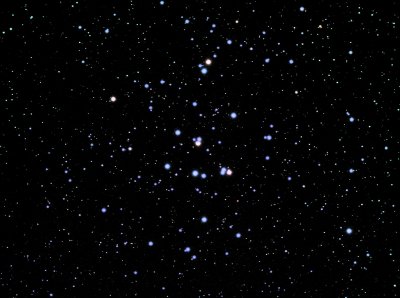
Astro-Tech AT66ED, ST2000XM, 30:24:20:20 minutes, 76' x 102' The Beehive is a young, sparse, very blue open cluster. It is a delightful binocular object in the center of Cancer but not a very exciting imaging target. This image was acquired at my home in The Woodlands, TX, where light pollution makes anything but open clusters difficult. |
|
|
|
|
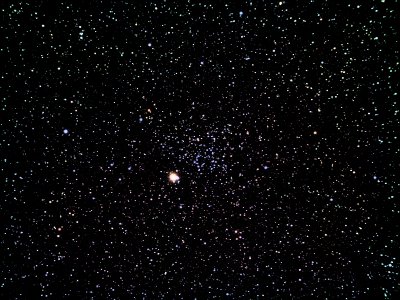
Astro-Tech AT66ED, ST2000XM, 20:16:14:10 minutes, 76' x 102' This very pretty open cluster in Puppis was imaged the night after M44, above. The exposures were cut a little short because I could see I was heading to the trees and, in fact, my last two blue exposures were lost because of this. I usually shoot equal exposures in green and blue, with about 25% more in red, based on the G2V calibration for my camera. One of the "missing" NGC objects, NGC 2542, was recorded just a few arc seconds from 19 Puppis, the bright star at SE edge of NGC 2539. It is probably missing because of an error in the initial recording of it's position. This object was imaged from The Woodlands, TX. |
|
|
|
|
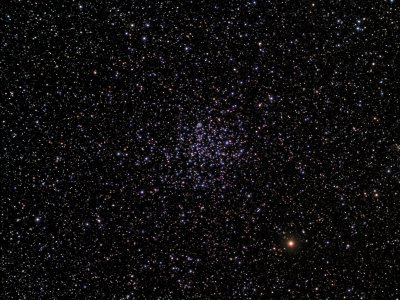
Astro-Tech AT66ED, ST2000XM, 24:20:16:16 minutes, 76' x 102' The large, rich, blue open cluster is M46 (NGC 2437),and the tiny planetary is NGC 2438. NGC 2438 is very nearly a twin of the Ring Nebula, but much smaller. While it appears to be part of the cluster, it is now thought to be just a chance alignment. I find the percentage of blue stars within the cluster compared to the percentage outside the cluster to be striking. With NGC 2438 and the very orange bright star SW of the cluster, it is a colorful and beautiful field. This is another image from my observatory in West Point, TX. |
|
|
|
|
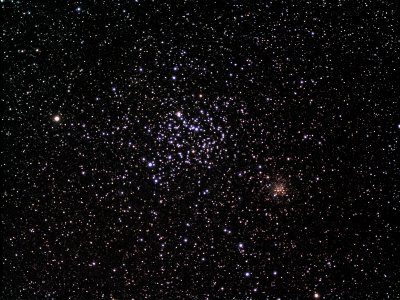
Astro-Tech AT66ED, ST2000XM, 44:28:24:24 minutes, 76' x 102' Messier 35 is the large, young open cluster at the center of the field. NGC 2158 is the much smaller cluster to the SW. It has almost five times as many members as M35 but is about six times more distant. The yellow color is probably partially due to the age -- it is a much older cluster than M35 -- and partially the result of absorption by intervening dust. Together, they make a beautiful pairing. My telescope is not a true ED, as you can see from the halos around the brighter blue stars, but it still provides a pretty decent image. |
|
|
|
|
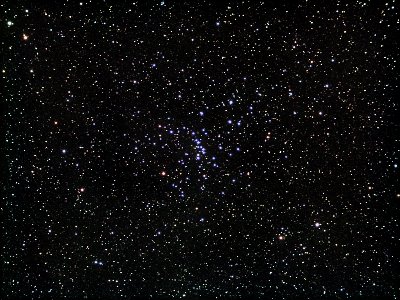
Astro-Tech AT66ED, ST2000XM, 16:16:16:16 minutes, 76' x 102' This very young, very blue, cluster occupies the center 54' of the field but does not really stand out. Somewhat surprisingly, it is much more obvious in my 9 x 50 finder than in the image. The image includes a huge number of background stars that are below the magnitude visible in the finder. To me, the most interesting things about this cluster are a horseshoe shaped collection of stars with the closed end at the center of the field and opening to the lower left (SE), and several long chains of stars just above the cluster that look almost like writing. |
|
|
|
|
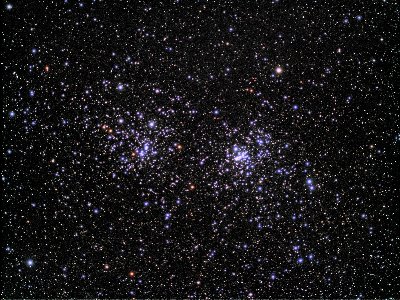 Double Cluster (NGC 869 & 864) Astro-Tech AT66ED, ST2000XM, 30:16:16:16 minutes, 76' x102' This is an image made from my backyard in The Woodlands, TX. Open clusters are about the only deep sky objects which can be easily be imaged with the light pollution, except for bright and planetary nebulae using narrowband filters. The Double Cluster is a beautiful object visually, even with binoculars or a small telescope. In dark skies, it can be found fairly easily with the naked eye. This is a replacement image which improves on the previous version by having triple the exposure time, 1x1 binning, and no Moon lighting up the scene. |
|
|
|
|
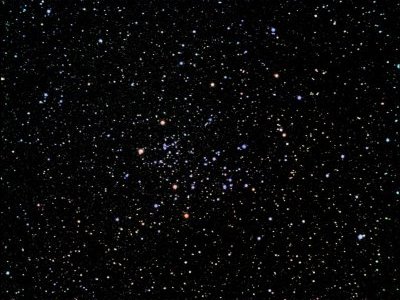
Astro-Tech AT66ED, ST2000XM, 10:10:10:10 minutes, 76' x102' NGC 1746 is smaller and denser than NGC 752 below, and appears even richer because it is seen against a background of stars on the fringes of the Milky Way. |
|
|
|
|
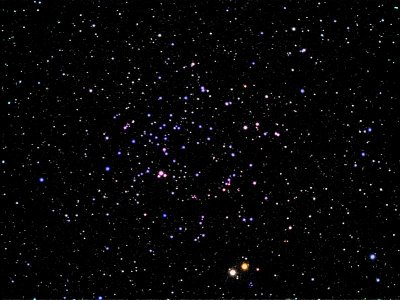
Astro-Tech AT66ED, ST2000XM, 10:10:10:10 minutes, 76' x102' NGC 752 is a very large, very sparse open cluster but the stars show some attractive color contrasts. There are probably about 65-70 members. While it is not often imaged and not very impressive either in an image or at the eyepiece, it is an interesting cluster with a lot of astrophysical work done on it. Burnham devotes four full pages to this object. |
|
|
|
|
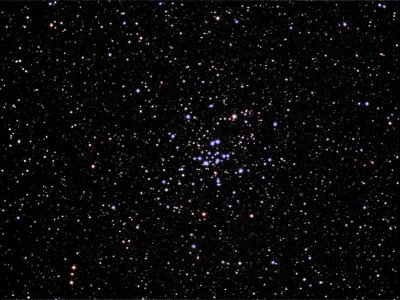
Astro-Tech AT66ED, ST2000XM, 20:12:10:10 minutes, 76' x 102' Messier 34 is a moderately large, loose open cluster in Perseus. The blue giant stars really dominate this cluster.
|
|
|
|
|
 |